General Purpose Survey Tool Comparison

Request Demo

CustomerGauge vs General-Purpose Survey Tools

Your Survey Tool Is Collecting Data.
Your Business Is Losing Revenue.

You built a survey program. Customers responded. You got data. And yet churn still surprised you,
your CFO still doesn't know what CX is worth, and your response rates are dropping every quarter.
The tool isn't broken. The approach is.

Sound Familiar?

"Customer centricity — it's like world peace. Nobody says no to it. But then the question is, okay, what exactly is that? How do you put it into action?"

VP, Commercial Excellence,
Enterprise Medical Device

"We had a dashboard, but it didn't tell the story like we needed to tell the story. We had to prepare the year-end report completely outside the platform."

Customer Experience Manager,
Enterprise B2B

"The closing the loop piece was really absent in the past. Those experiences helped shape our understanding of what good should look like and what gaps we needed to plug."

Partner Experience Leader,
B2B Technology

"You gave the financial equation — allowed it to go into financial metrics — which our tool doesn't do."

Beth S.,
CX Leader

"It's not scalable and it's not built for the future."

Director,
CX Strategy

"We're charging the client back for the effort. Both teams are currently looking for an alternative solution due to functionality concerns and cost concerns."

Customer Insights,
Consultant

The Problem With General Survey Tools

Invisible Revenue Impact
General-purpose tools treat all feedback equally because they don't know the financial weight of the person responding. They fail to identify when a response comes from a high-value account, such as one worth $2M in ARR, leaving critical revenue risks hidden in a sea of data.
Lack of Automated Accountability
These platforms are "silent" after the data is collected. They do not automatically route critical customer responses to the specific account managers who need to act on them, creating a disconnect between receiving feedback and taking necessary action.
No Follow-Up Tracking
While these tools are excellent at collecting data, they provide no visibility into the "aftermath." There is no system to track whether anyone in the organization actually followed up with the customer, leading to a lack of accountability in the closing of the loop.
Blindness to Negative Trends
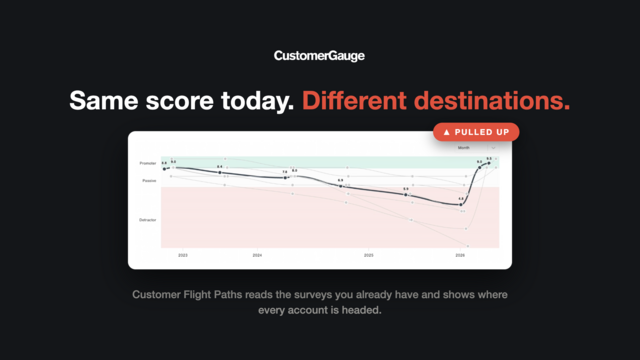
General-purpose tools often fail to connect historical patterns or revenue trends. They don't alert you when an account's sentiment is steadily declining such as dropping from a 4 to a 3 especially when the organization has failed to respond to previous feedback.
Product Mockup General 2

What a Real B2B CX Program Looks Like

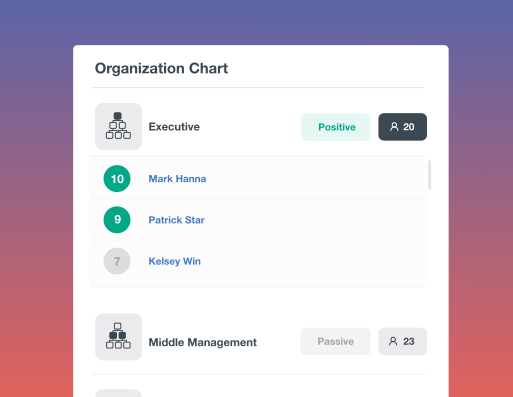
Account Centric Org Chart

Account-Centric NPS®, The Way B2B Actually Works

General survey tools treat a $50K and $3M account the same. That is dangerous. CustomerGauge’s patented Account-Centric NPS methodology aggregates all respondents into a weighted health score. You see the relationship, not just a response. While others show a "fine" average for an account with a disgruntled VP, we show you the risk. Account managers see reality and never get blindsided.

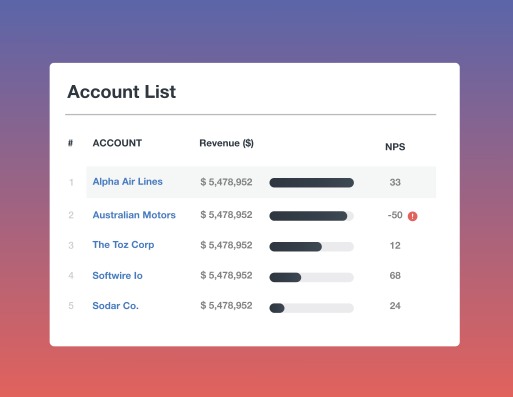
Revenue Based NPS Account List

Revenue-Based NPS, The Answer to the Question That Kills Programs

Every CX program faces a moment where leaders ask what it's worth. General tools fail by not connecting to the P&L. CustomerGauge’s Revenue-Based NPS links account scores to ARR, risk, and expansion in real time. When scores drop, you see the exact revenue at risk. This turns CX into a growth lever and revenue protection function. You enter board meetings with facts, not just scores.

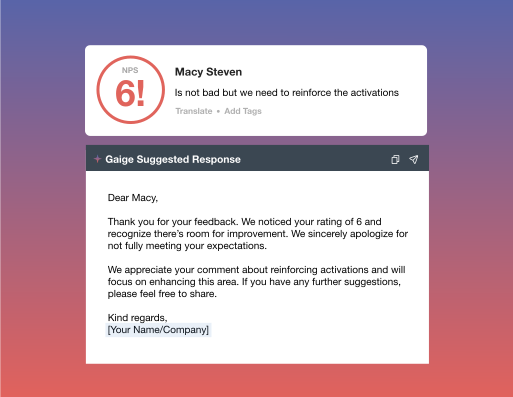
Acting On Feedback Suggested Response

Close the Loop Or Watch Your Response Rates Die

General tools end when data is collected. Close-the-loop becomes an afterthought of manual exports and buried Slack messages. CustomerGauge makes action a core function. When a detractor responds, the platform automatically routes alerts, triggers workflows, and tracks deadlines. Response time and loop-close rates become primary KPIs. When feedback leads to real conversation, response rates climb and churn drops. Feedback becomes how your company runs.

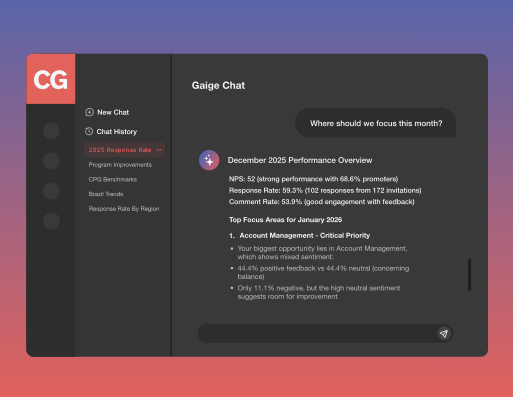
Dashboards Analytics Gaige Chat

Gaige AI: Intelligence That Drives Action, Not Just Analysis

General tools offer basic analytics that tell you what customers said, but not what to do. Gaige AI conducts real conversations, interviewing customers with follow-up questions to get qualitative depth at scale. It surfaces actions, not just insights, recommending specific steps weighted by revenue at stake. It answers executive questions on churn risks and moves the NPS needle. Your team spends less time reading dashboards and more time protecting revenue.

Partner product shot

A Program Partner, Not a Survey Vendor

General-purpose tools give you a license, not a partner. They won’t design your B2B program, train your team, or help explain results. CustomerGauge embeds with you, brings industry expertise, and focuses on outcomes. The result is faster time to value, higher adoption, and insights you can actually report.

Head-to-Head: CustomerGauge vs. General-Purpose Survey Tools

Logo customergauge black Large

Account-Level NPS (Not Contact-Level)

Tracks NPS across entire accounts, giving a holistic view of customer sentiment.

Patented Methodology
Individual Responses Only

Revenue-Linked NPS Scores

Tracks NPS across entire accounts, giving a holistic view of customer sentiment.

Built Into Every Dashboard
No Revenue Connection

Churn Risk Alerts Tied to ARR

Monitor ARR impact by tracking churn risk signals for key customers.

Real-Time, Automated
Not Possible

Close-The-Loop Automation

Streamline your feedback process with automated task creation and follow-ups.

Built-In Routing + Case Management
Manual, if it happens at all

AI-Powered Customer Interviews

AI interviews capture deep insights and NPS at scale with no added effort

Gaige AI — conversational, revenue-weighted
Word clouds and sentiment tags

Executive Revenue Reporting

Clear, actionable revenue insights designed for executive decision making

CFO-ready, tied to ARR
Response rates and score trends

Response Rate Improvement Tools

Boost response rates with tools that increase engagement and feedback volume

Loop-close drives repeat engagement
No mechanism to rebuild trust

Program Advisory Support

Expert guidance to help you design, improve, and scale your program fast

Embedded CX practitioners
Documentation & help desk

B2B Distributor / Channel Feedback

Gather actionable insights from your partners and distributors in one place.

Core Use Case
Not Designed For This

Ease of Setup (G2)

Earned the highest Ease of Setup rating in the Implementation Index.

8.6 / 10
Not Available

Best Support (G2)

Earned the highest Quality of Support rating in the Relationship Index.

9.6 / 10
Not Available

Good Business Partner (G2)

Earned the highest Ease of Doing Business With rating in its category.

9.5 / 10
Not Available

Product Direction (G2)

Satisfaction rate regarding the product’s roadmap, vision, and development.

9.7 / 10
Not Available
Get Started

Frequently Asked Questions

General survey tools are platforms like SurveyMonkey, Salesforce, and various homegrown solutions that are primarily designed to help you collect feedback data quickly and efficiently.

Nothing is wrong with those tools for what they were built to do. They collect data efficiently, they're easy to set up, and they're cheap. The problem is that collecting data was never the hard part of running a B2B CX program. The hard part is everything that happens after a customer responds. General-purpose tools are completely silent on that. They don't know the person who just gave you a 3 is worth $2M in revenue. They don't route that response to anyone. They don't track whether anyone followed up. They don't connect that score to a renewal coming up in 90 days. You get a dashboard. Your customer gets silence. And silence is what kills response rates.

Because acceptable response rates and stable NPS scores are lagging indicators. The customers who've already decided to leave often stop responding first. The quiet middle of your account base, your most at-risk segment, disengages before you see it in the numbers. By the time your scores start moving, the damage is already done. The question isn't whether your current numbers look okay. It's whether your program is actually protecting revenue or just measuring sentiment.

It's simpler to set up. It's not simpler to run a program on. Salesforce Surveys gives you survey capability inside a CRM, but it doesn't give you Account-Centric NPS methodology, revenue-weighted alerts, close-the-loop automation, or AI that tells your team what to do next. You still end up with the same fundamental problem: data collected, nothing actioned. One of our customers described evaluating their existing tech stack options and realizing that built-in survey capability was fine for checking a box, but not for building a program that leadership would actually fund.

Almost always the same thing: customers gave you feedback, nothing happened, and they stopped bothering. This isn't a deliverability problem or a survey design problem. It's a trust problem. The B2B customer who spent five minutes telling you your onboarding process was broken, and then six months later got the same survey with the same broken onboarding, has learned that their feedback doesn't matter. No amount of subject line optimization fixes that. The only thing that fixes it is closing the loop, and general-purpose tools have no mechanism for doing that.

Sharing a dashboard is not closing the loop. Closing the loop means a specific person received a specific customer's feedback, followed up with that customer directly, and the customer knows their input led to something. CustomerGauge tracks all three: whether the alert was routed, whether the follow-up happened, and how quickly. Loop-close rate is measured as a primary KPI alongside NPS itself because it's what actually moves the number over time. If your account managers are looking at a shared dashboard and deciding what to act on, the highest-value detractors are not reliably getting followed up with. They're competing with everything else on the account manager's plate.

Partly. General-purpose tools measure feedback volume, response rates, and score trends. None of those connect to the P&L. So when your CFO asks what the program has produced, you show them an NPS trend line and a deck of verbatim quotes. That's a research program answer, not a revenue program answer. CustomerGauge's Revenue-Based NPS connects every account score to live ARR, renewal dates, and expansion opportunity. When you can say "our NPS improvement this quarter protected X in renewal revenue and we have Y accounts currently at risk representing Z in ARR," you're having a completely different conversation with your leadership team. That's what gets programs funded.

Standard NPS, including what general-purpose tools measure, treats every respondent the same. One contact, one data point. In B2B, that's dangerous. A single account might have 10 stakeholders. If you survey one and they're a promoter, your current tool shows you green. But the VP of Operations who controls the renewal decision is furious and you have no idea. CustomerGauge's patented Account-Centric NPS aggregates all respondents at the account level, weights them appropriately, and gives you a single account health score that reflects the full relationship. You can't replicate this by filtering a SurveyMonkey export. It's a fundamentally different data model built specifically for how B2B relationships actually work.

Revenue-Based NPS connects every account score to live ARR, renewal date, and expansion opportunity in real time. When a score drops, you see immediately how much revenue is at risk. When your program improves NPS across your top tier, you can quantify what that's worth and put a number in front of your CFO. This is how CX stops being a cost center and starts being a revenue protection function. General-purpose tools can't do this because they have no revenue data. They measure feedback in isolation. CustomerGauge measures feedback in the context of what each account is actually worth to your business.

General-purpose tools give you bar charts, trend lines, word clouds, and maybe some sentiment tagging. They tell you what customers said. Gaige AI tells you what to do about it. Specifically: it conducts real conversational interviews with your customers at scale, asking follow-up questions based on what they just said rather than running through a static form. It generates personalized follow-up responses for your account managers so they can close the loop fast. It produces account relationship summaries that surface the next best action, prioritized by revenue at risk. And it answers executive questions directly through a conversational interface: what's our biggest churn risk this quarter, which accounts need a call this week, what's the one thing we could fix that would move NPS the most. Your current analytics tool answers none of those questions.

The close-the-loop mechanism is the primary driver. When customers see their feedback leads to a real conversation and something actually changes, they respond again. It's a trust cycle rather than a decay cycle. CustomerGauge customers average 16%+ response rates. Trivium went from an unknown baseline to a 44% account response rate within a year. Beyond that, CustomerGauge provides region-specific survey playbooks built from 18+ years of what actually works across different industries and markets. You're not guessing at best practices. You're deploying them.

CustomerGauge integrates natively with CRMs, helpdesks, and ERPs in real time. The practical difference from a general-purpose tool integration is depth and maintenance. When a new field gets added to your CRM, or your data warehouse schema changes, CustomerGauge's engineering team handles it. General-purpose tool integrations are typically shallow exports or Zapier connections that break quietly and stay broken until someone notices an account manager hasn't received an alert in three weeks.

Less disruptive than staying on a tool that isn't protecting revenue. CustomerGauge is consistently described by customers as intuitive and fast to get running. Anheuser-Busch saw significant results within the first hour of going live. The onboarding model is designed to get commercial utility fast: identify at-risk accounts, route detractors, get account managers following up. You don't need to migrate years of survey history or rebuild your entire program from scratch. Most customers start a focused pilot, prove the value internally, and expand from there.

Not entirely. The customer relationships, the institutional knowledge about what drives satisfaction in your accounts, the internal champions you've built. None of that goes away. What you're replacing is the tool layer that's been limiting what you can do with all of it. Think of it less as starting over and more as finally having the infrastructure to make your existing investment pay off.

The revenue connection is usually what moves leadership. When you can show an exec team which accounts are at risk and exactly how much ARR is exposed, the program stops being a line item and starts being a business-critical function. CustomerGauge's ROI Calculator at customergauge.com helps you build that case before you've signed anything. On the team side, customers consistently describe the onboarding experience as feeling like an extension of their own team rather than a vendor relationship. That matters because you need your program champion to feel supported, not alone.

CustomerGauge scores 9.6/10 for Quality of Support and 9.5/10 as a good business partner on G2, both among the highest in the category. Support includes embedded CX practitioners who understand B2B program design, not just the technical platform. Customers describe the relationship as genuinely invested in program outcomes rather than just keeping the software running. That's a structural difference from general-purpose tools where support means documentation and a help desk ticket.

The question is what your current tool is costing you in undetected churn, unfollowed detractors, and a CX budget that leadership won't grow because nobody can prove it's working. HPTronic generated nearly $6 million in sales referrals with a 47% close rate through CustomerGauge. H&R Block Canada saw a 17% increase in top-line revenue. SuperOffice described the platform as paying for itself through direct referral sales. The ROI conversation flips quickly when you connect the program to revenue outcomes rather than comparing license fees.

CustomerGauge works across a wide range of B2B company sizes. The methodology scales: whether you have 50 key accounts or 50,000, the Account-Centric NPS model and close-the-loop system work the same way. Smaller companies often find the biggest immediate wins because the gap between "we have no systematic loop-close process" and "every detractor gets followed up with in 48 hours" is most visible at that stage. The question isn't size, it's whether your accounts are worth protecting. If they are, the program pays for itself.

Survey fatigue is real, but it's almost always caused by irrelevance and non-response, not by volume. Customers don't mind being asked when they believe something will happen as a result. Gaige AI's conversational interview format actually tends to improve engagement because it feels like a real conversation rather than a form. And because the close-the-loop system ensures customers hear back, the program builds trust over time rather than eroding it. The companies with the worst survey fatigue are almost always the ones running general-purpose tools where nothing happens after the response.

Standard NPS has real limitations in B2B, which is exactly why CustomerGauge built Account-Centric NPS. The contact-level averaging problem, the inability to weight by account revenue, the lack of multi-stakeholder visibility. These are all NPS implementation problems, not NPS methodology problems. When you fix those, NPS becomes the most powerful metric available for B2B because it's simple enough to operationalize at scale and rich enough to connect to revenue outcomes. The companies that have abandoned NPS in B2B almost always abandoned the general-purpose implementation of it, not the methodology itself.

What is Your General-Purpose Survey Tool Costing You? Find Out Here

Calculate ROI
Ready to See CustomerGauge in Action?
Request a Demo

Get Started

Experience Benchmarks

Get The B2B Experience Benchmarks

With over 24,000+ data points collected across 12 B2B industries, this is the most comprehensive B2B NPS & CX benchmarks report on the planet.

B@B

Calculate Your
Experience ROI


See the impact CustomerGauge could have on your bottom-line.