CustomerGauge vs Homegrown & In-House CX Solutions
Your Engineering Team Didn't Sign Up to Be Your CX Department.
You built something. It works...mostly. But between the maintenance tickets, the broken integrations, the survey logic someone hardcoded two years ago, and the dashboard that only one person knows how to update, your in-house tool has become a second job for people whose first job has nothing to do with customer experience.
And after all that effort, all that cost, all that internal political capital spent justifying the build you're still just collecting data.
"It's really manual at the moment. I have to go in and update filters and stuff like that. There's nothing that allows me to just do it automatically."
Head of B2B CX and Journey
"We needed a lot of workarounds. It took a lot of time. It's not an ideal situation for the team but they're now used to it."
Director,
CX Strategy
"We built dashboards internally and in Tableau because the platform just couldn't do what we needed. It became cost-prohibitive to give access to everyone who needed it."
CX Leader,
B2B Technology
"We have to go outside for all sorts of services. We've had to bring in a third party, and then the third party builds to our tool and the third party can build to it, but we have to manage that too."
Quality and Training Supervisor
"It's not scalable and it's not built for the future."
Director,
CX Strategy
"We're limited in what we can do because of what we have — and everyone is completely aware of that. There's only so much you can do with what you have to work with."
CX Program Lead
The Problem With In-House CX Solutions
The True Cost of Building It Yourself
When companies build in-house CX tools, it often starts with “we’ll save on license fees.” It sounds logical, but the gap between promise and reality grows over time, quietly turning into hidden operational and engineering cost.
The Ongoing Cost No One Plans For
The initial build is rarely the problem. The real cost comes after: every CRM change, dashboard request, or data update creates ongoing engineering work. These tools don’t have a maintenance phase, they have permanent upkeep handled by high-cost teams.
Frankenstein Tools Break at the Worst Possible Moment
In-house CX tools evolve into fragile systems with many failure points across integrations and dashboards. When something breaks, alerts fail, surveys stop, and decisions get made on stale data. In B2B CX, that doesn’t just lose data, it loses customers.
Still Just a Research Tool, Even If It Works Perfectly
Even when they work, homegrown tools mostly collect and display data. They don’t automate actions, prioritize revenue impact, or guide next steps. Building that requires years, while purpose-built platforms already deliver it today.
What CustomerGauge Does That You Can't Build Fast Enough
Account-Centric NPS® The Methodology Your Engineers Can't Replicate
CustomerGauge's Account-Centric NPS methodology goes beyond simple survey collection. It aggregates feedback across stakeholders, weights responses by account context, and produces a single health score that reflects the full relationship, not just an average that hides key signals from decision makers in complex B2B accounts.
Revenue-Based NPS, Connecting Feedback to the Number That Matters
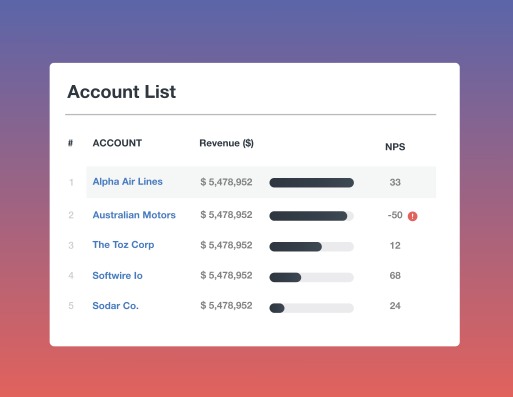
Most in-house tools can technically link feedback to revenue, but rarely do it well. CustomerGauge natively connects NPS to ARR, renewal timing, and expansion potential in real time, allowing teams to quantify risk and opportunity so CX leaders can prove impact, secure funding, and directly tie improvements to financial outcomes.
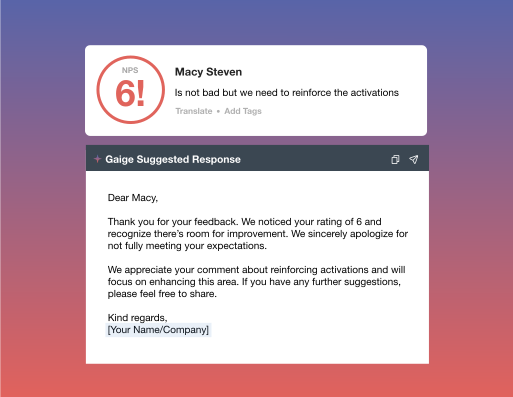
In-house tools often rely on manual processes to close the loop, which leads to inconsistent follow-up and declining response rates. CustomerGauge automates routing, workflows, and accountability so detractors are actioned quickly, making feedback visible, measurable, and tied to outcomes that customers can actually see.
Gaige AI: The Capability Gap You Can't Close In-House
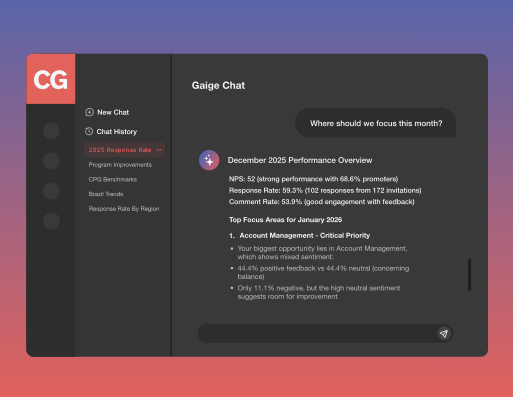
Gaige AI goes far beyond surveys by conducting conversational interviews that adapt in real time, uncovering deeper qualitative insights at scale. It also delivers intelligent follow-ups, recommends next actions weighted by revenue, and answers executive questions by synthesizing feedback, account history, and financial data into clear guidance.
A Platform That Never Stops Improving, Without Your Engineers
Unlike in-house systems that depend on internal resources for every update, CustomerGauge continuously ships improvements, features, and fixes across all customers. Dedicated teams maintain reliability and performance so your engineers can focus elsewhere while your CX capability keeps evolving without added internal workload.
Ready to Move Beyond Scores? Pick an option to get started with CustomerGauge today!
Get in Touch - Request a Demo
Pick a Date
Learn More - Watch a Demo
Watch Here
The B2B NPS & CX Benchmarks Report
Read The Report
Frequently Asked Questions
You can build the survey and data collection parts. Most companies do. The problem is that collecting data is the easy part of running a B2B CX program, and it's the only part a build addresses. What you can't build fast enough is the decade of B2B CX methodology behind Account-Centric NPS, the revenue integration layer, the close-the-loop automation, and the AI that surfaces what to do next. By the time you've built those, the market has moved on and your competitors are already using them.
The initial build is usually the smallest part of the cost. What companies underestimate is the permanent maintenance burden that follows: CRM changes, dashboard requests, integration updates, broken pipelines. In practice, this consumes roughly 10% of your most expensive people's time, indefinitely. That's before accounting for the opportunity cost of engineering capacity diverted from your actual product.
The question isn't whether it works. It's whether it's driving revenue or just collecting data. Most in-house tools do the latter very well. They cannot automatically route a detractor to the right account manager. They cannot weight that alert by the ARR attached to the account. They cannot tell you whether anyone followed up. They cannot show your CFO what the program is worth. If your current tool can't answer the question "what has this program produced in retained revenue?" it's a research tool, not a revenue tool.
Two risks compound over time. First, operational: in-house tools are Frankenstein systems. Survey tool connected to a data warehouse, connected to a dashboard built in Tableau, connected to a CRM integration configured by someone who left. Each connection is a failure point with no one watching it overnight. When it breaks, accounts go unheard, detractors slip through, and nobody connects the dots when they churn three months later. Second, strategic: you're stuck collecting data while your competitors are acting on it. The gap between "we survey customers" and "we close the loop in 48 hours on every detractor, weighted by ARR" is a competitive gap, and it widens every quarter you wait.
Standard NPS measures individual contacts. In B2B, a single account may have 10 stakeholders, and surveying one of them tells you almost nothing about the health of the relationship. CustomerGauge's patented Account-Centric NPS aggregates responses across all stakeholders at an account, weights them appropriately, and produces a single account health score. If your biggest account has two promoters and one very unhappy VP of Operations who's already talking to your competitor, standard NPS shows you a middling average. Account-Centric NPS shows you a risk.
Revenue-Based NPS connects every account score directly to live ARR, renewal date, and expansion opportunity. When a score drops, you see exactly how much revenue is at risk. When your overall NPS improves, you can quantify what that's worth and bring a real number to your CFO. This is what transforms CX from a cost center into a revenue protection function, and it's what makes the program fundable long-term. Most in-house tools could theoretically join NPS data to revenue data, but in practice it rarely happens cleanly, consistently, or in real time.
No. Gaige AI has three core functions that no in-house tool replicates. It conducts real conversational interviews with customers at scale, asking intelligent follow-up questions based on what the customer just said rather than running through a static form. It generates AI-powered follow-up responses for your account managers, which is why 50% of CustomerGauge clients close the loop within 48 hours. And it produces account relationship summaries that tell your team what to do next, prioritized by revenue at risk. It also includes a conversational interface where you can query your entire CX dataset and get direct answers to executive questions like "what's our biggest churn risk this quarter?"
Closing the loop means following up with a customer after they give you feedback. Acknowledging what they said, telling them what you're doing about it, and tracking whether it actually happened. Most in-house tools have no mechanism for this. Feedback sits in a dashboard. Nothing happens. Customers learn their input doesn't matter and stop responding. CustomerGauge makes close-the-loop a core system: detractors are automatically routed to the right account manager, workflows are triggered, deadlines are set, and loop-close rate is tracked as a primary KPI. Briggs Equipment achieved a 100% closed-loop rate three years running. H&R Block Canada saw an 8% increase in their closed-loop rate, a 16% NPS increase, and a 17% increase in top-line revenue.
CustomerGauge customers average 16%+ response rates. That compares favorably to industry norms because the close-the-loop mechanism creates a self-reinforcing cycle: when customers see their feedback leads to action, they respond again. Trivium went from an unknown response rate to a 44% account response rate within a year. Response rate degradation in general-purpose and in-house tools is almost always a trust problem. Customers stop responding because nothing happened last time.
CustomerGauge integrates natively with CRMs, helpdesks, and ERPs in real time. The difference from an in-house integration is who owns the maintenance. When your CRM schema changes or a new tool gets added to your stack, that's CustomerGauge's engineering problem, not yours. In-house integrations break and stay broken until someone finds them, often after accounts have already gone unheard.
Yes, this is a core use case. AB InBev deployed across 27 global markets with a multi-channel always-on feedback approach that adjusts by market. Coca-Cola HBC reaches 566,000 customers worldwide every day with 99% revenue coverage. The platform is built for exactly the complexity that in-house tools struggle to handle at scale: multiple stakeholders per account, distributor and channel relationships, multi-region programs.
CustomerGauge is designed for fast time to value. Anheuser-Busch saw significant results within the first hour of going live. After a 3-month pilot, Marel was convinced it was the right global solution. The platform is consistently described by customers as intuitive and easy to navigate without extensive training. The program's long-term value compounds over time. Most customers start by proving commercial utility fast: identify at-risk accounts, route detractors, get account managers following up. Then they build toward strategic ROI through retention and expansion data. You don't need to boil the ocean on day one.
Two things. First, the revenue connection. When your leadership team can see which accounts are at risk and how much ARR is exposed, the program stops being a nice-to-have and starts being business-critical. Second, the partnership model. CustomerGauge embeds with your program. Customers consistently describe the relationship as an extension of their own team rather than a software vendor. That matters enormously for internal adoption because your program champion isn't out there alone trying to make the case.
Revenue-Based NPS exists specifically to solve this problem. When you can show your CFO that a 5-point NPS improvement across your top accounts is worth X in retained ARR, the conversation changes. Multiple customers describe the same arc: initial skepticism from leadership, then conversion once the revenue connection became visible. The ROI Calculator at customergauge.com can help you build that initial business case before you've even started the program.
CustomerGauge scores 9.6/10 for Quality of Support and 9.5/10 as a good business partner on G2, consistently the highest-rated categories in customer reviews. The model includes embedded CX practitioners, not just technical support. Customers describe sessions where the CustomerGauge team presents directly to their executive teams, helps them interpret their data, and coaches them on program maturity. That kind of engagement is structurally impossible with a homegrown tool. There's no vendor to hold accountable, and no one whose job it is to make your program succeed.
That's a fair concern. It's worth weighing against the dependency you already have on the one or two internal people who built and maintain your current system. Institutional knowledge locked in one person's head is a fragile dependency too. CustomerGauge has been operating since 2007, runs programs in 160+ countries, and is ranked number one for B2B by Gartner. The program data you build belongs to you. The more useful question is whether your current tool is producing something worth protecting, and for most in-house programs, the honest answer is not yet.
CustomerGauge works at multiple stages of program maturity. New programs typically start with proving commercial utility fast: routing detractors, getting account managers to follow up, showing leadership something tangible. Then they build toward more sophisticated revenue analytics over time. What you don't want is to outgrow your in-house tool at the moment your program starts getting real traction. Rebuilding mid-stride costs far more than starting right.
NPS is the methodology CustomerGauge is built around, and Account-Centric NPS specifically addresses the known limitations of standard NPS in B2B, particularly the contact-level averaging problem that masks account-level risk. The platform also supports additional survey types and transactional feedback. The more relevant question is whether you want a metric that connects to revenue. If the answer is yes, NPS with Revenue-Based NPS is the most direct path to that conversation with your CFO.
What is Your Homegrown Survey Tool Costing You? Find Out Here
 Platform Capabilities
 Only With CustomerGauge
 The B2B Experience Platform
CustomerGauge is the only B2B experience solution built for real-time feedback and actionRequest a Demo
The B2B Experience Platform
CustomerGauge is the only B2B experience solution built for real-time feedback and actionRequest a Demo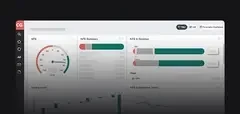
 By Industry
 Compare Us To