



The Delighted Sunset: Three Options for B2B Teams (and the One Most Are Missing)
Delighted is sunsetting on June 30, 2026. Teams running NPS or CSAT programs on the platform need a replacement, stat, and Qualtrics, which owns Delighted, is (what a shock!) recommending its own XM Suite as the migration path. For most consumer-facing teams running mass-market feedback, the replacement decision is a straightforward survey-tool swap. There are roughly seven good tools that can do the same things.
For B2B teams whose revenue is tied to account renewals, the decision looks a LOT different. While the Delighted sunset is being framed as a "tool migration question," for B2B revenue growth, it is a "CX PROGRAM question."
Here is how the decision actually breaks down.
What Is the Best Alternative to Delighted in 2026?
Short answer: none. The right replacement for the Delighted survey platform depends on a question few are asking: are you measuring NPS at the contact level, or do you actually need it at the ACCOUNT level? For B2C teams running mass-market feedback at the individual respondent level, the obvious moves are the obvious moves: SurveyMonkey, Typeform, Survicate, or any of a half-dozen tools that do roughly what Delighted did. For B2B teams whose revenue is tied to account renewals, that path preserves the wrong measurement frame. That is Option 2 below, and for a B2B team it is rarely the right one. Account-level NPS platforms like CustomerGauge measure feedback across multiple stakeholders per account, then tie that feedback DIRECTLY to revenue. The Delighted sunset may look like a tool decision. We'd argue it's actually a CX PROGRAM decision.
"The Delighted sunset is forcing a tool decision. For B2B teams, it's actually a CX program decision, with three real options to weigh."
The Delighted Sunset Timeline and What Actually Happens to Your Data
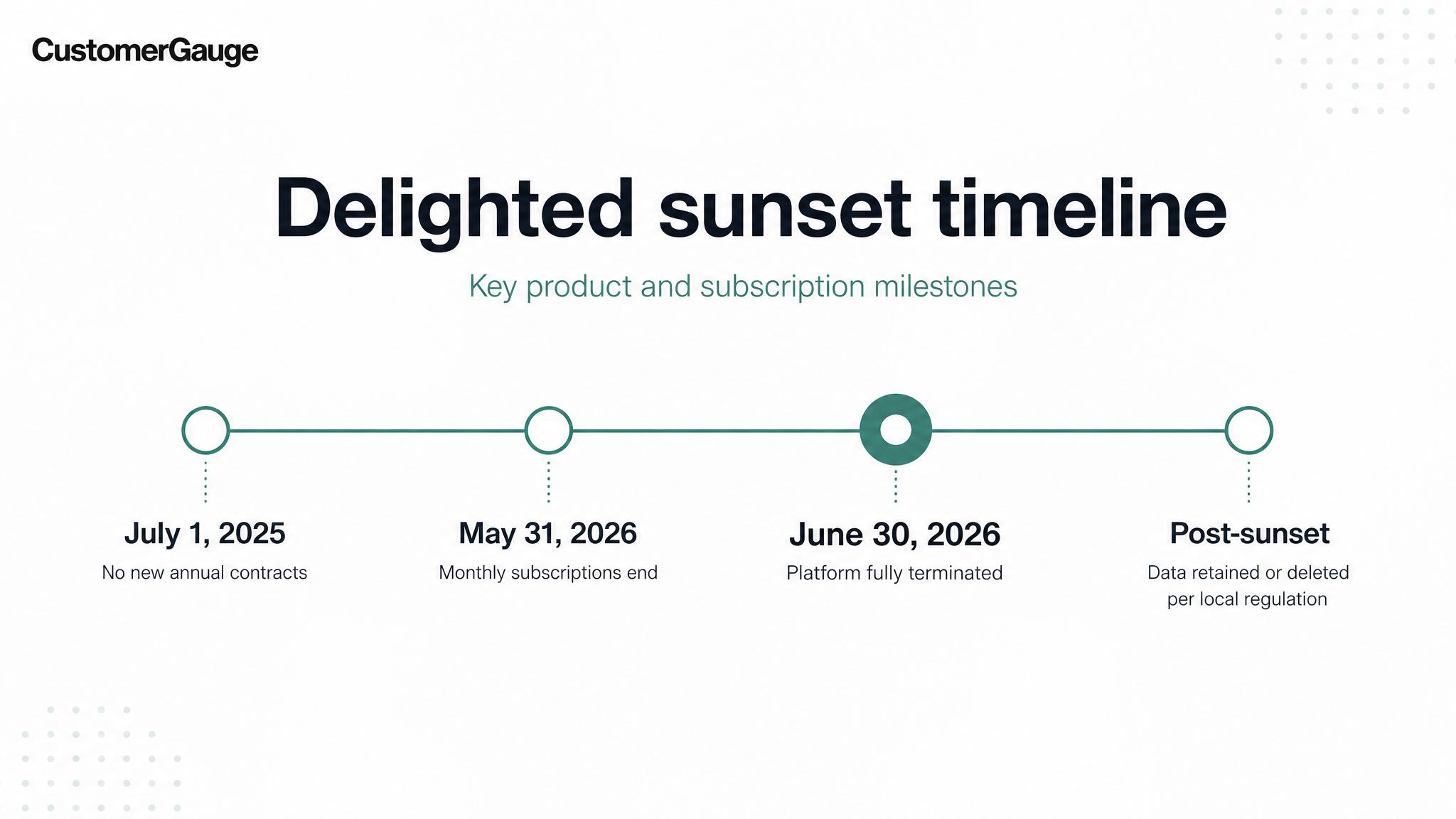
Qualtrics announced the Delighted sunset in mid-2025, and the wind-down is structured across roughly a year.
Key dates
The publicly disclosed timeline runs as follows: (1) July 1, 2025, Delighted stopped accepting new annual contracts; (2) May 31, 2026, monthly subscriptions end; (3) June 30, 2026, the platform is fully terminated; (4) following termination, customer data is retained or deleted per local regulations, not per the customer's preferred timeline. Teams still on the platform have a hard deadline, not a soft one.
What Qualtrics is recommending, and why it's not automatic
Qualtrics owns Delighted and is recommending migration into the Qualtrics XM Suite. That path makes sense for some teams, particularly those already inside the Qualtrics ecosystem or running enterprise-scale research operations. It is not, however, a simple one-click migration. Qualtrics XM is a weightier platform with a denser implementation footprint and a substantially higher cost. (We will get into specifics under Option 1 below.)
For teams who chose Delighted because it was simple and inexpensive, just "swapping out to the parent platform" is rarely the answer.
The historical NPS data preservation problem
What about historical data? Years of NPS trend data live inside Delighted. Most replacement platforms, including Qualtrics XM, will NOT preserve that history with full fidelity during migration. Some preserve scores but lose comment-level detail. Others preserve everything as flat exports that no longer drive live reporting.
For teams whose CX program leans on YoY trend continuity, the data fidelity question matters as much as the platform question.
(One credibility marker worth noting: the broader survey-tool sunset moment also includes GetFeedback Direct, which sunsets December 31, 2026. Only Direct sunsets, GetFeedback Digital continues. We'll cover that separately.)
"Years of NPS trend data live inside Delighted, and most replacement platforms, including Qualtrics XM, do not preserve that history with full fidelity during migration."
Three Options B2B Teams Are Actually Choosing Between
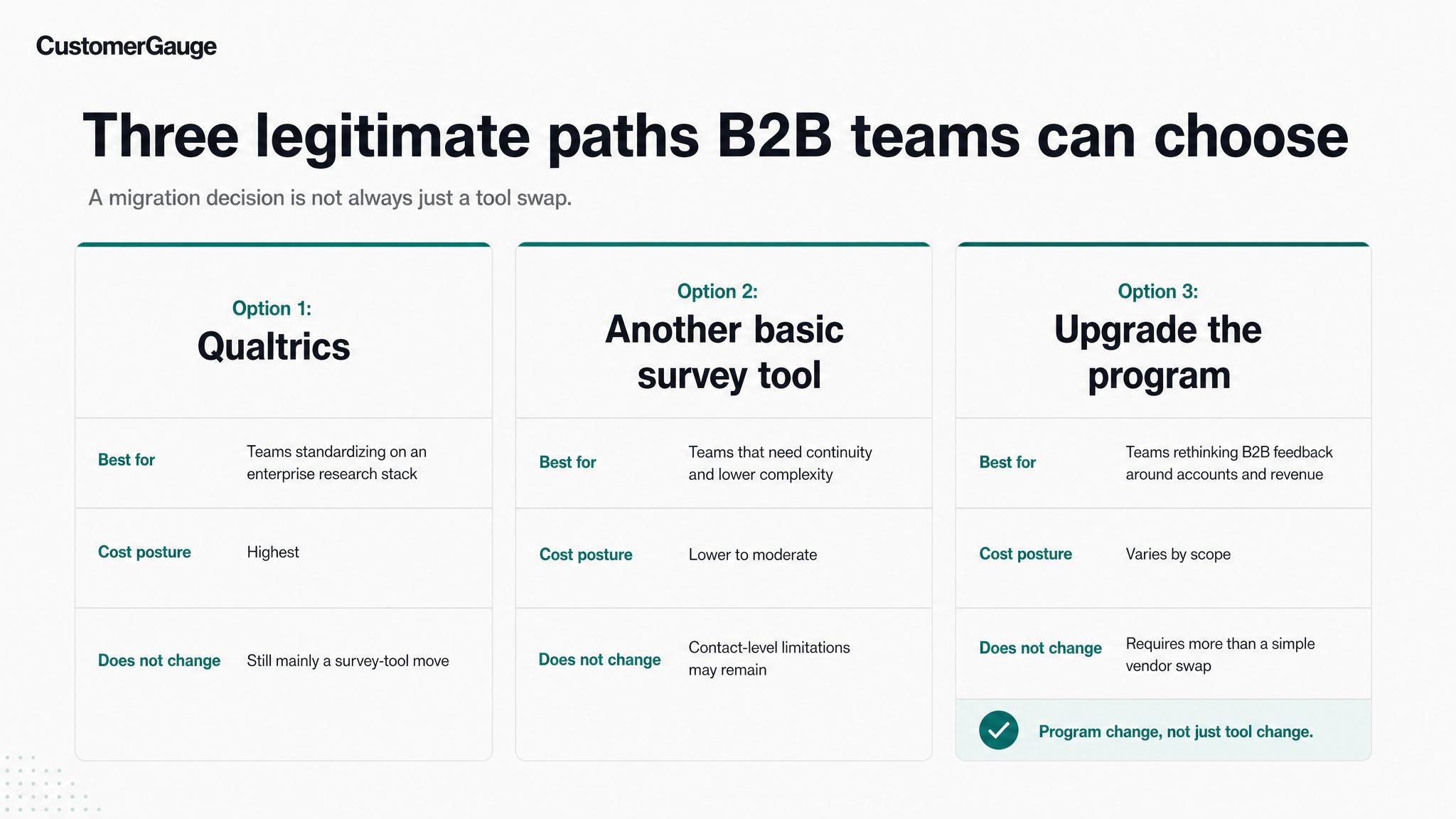
For most B2B teams who have just learned the news, the Delighted sunset feels like a choice between two options: a heavier survey tool, or a different simple survey tool. There is, in fact, a third option that no one is talking about (except us).
Option 1: Migrate to Qualtrics
The "simplest" path. Qualtrics owns Delighted and is the named recommended migration destination, which is the path of least friction on paper. For a subset of teams, particularly B2C teams, it is also the right call.
The Qualtrics XM Suite is a deep platform. Teams running mature research operations across product, marketing, employee experience, and customer experience often benefit from consolidating onto one stack. Enterprise organizations with dedicated XM teams and Qualtrics-trained internal analysts tend to absorb the migration cost reasonably well.
There are trade-offs, however. Industry migration content has reported mid-market Qualtrics deployments in the $50K-$100K range annually, with 3-6 month implementation cycles; larger enterprise quotes have been reported in the $400K+ range. For teams who chose Delighted in the first place because it was easy and inexpensive, scaling up to a research-heavy enterprise platform to replace a single-purpose NPS tool is a substantial step up in cost, configuration overhead, and ongoing admin.
Option 1 is the right call when the breadth of XM justifies the platform cost. When it doesn't, it turns into a prohibitively expensive way to keep doing what Delighted already did, at a fraction of the cost.
Option 2: Migrate to another basic survey tool
"Same movie, different director" = Same product category, different logo.
The field is genuinely crowded: SurveyMonkey, Typeform, Survicate, SurveySparrow, AskNicely, Zonka Feedback, Retently, and several others all occupy roughly the same product space Delighted did, lightweight NPS-and-CSAT distribution, single-respondent-per-contact survey logic, dashboard-style reporting, etc.
For B2C teams running mass-market feedback, this is often the right call. The product category fits the use case. Migration is relatively quick, the cost stays low, and the operational pattern doesn't change. None of the tools listed above are doing anything radically different from what Delighted was doing; they are variations on the same theme, and the teams who chose Delighted because it fit snugly with their workflows are the teams for whom Option 2 is a legitimate, low-friction landing spot. This is not a strawman path. For a team whose feedback program is working and just needs a new home, it is the sensible move.
What Option 2 DOESN'T do is change or IMPROVE what's being measured. The real trouble for B2B teams was drifting into a B2C-oriented tool because Delighted was simple and cheap. Option 2 is a fine answer when the measurement frame is right. For a B2B team whose revenue runs through accounts, it keeps the wrong frame in place.
Option 3: Use the moment to upgrade the CX program itself
If your revenue runs through accounts, this is the option that matters.
If your B2B company's revenue depends on account renewals, contract expansions, and multi-stakeholder relationships, the Delighted sunset is a rare opening to ask a question most teams don't otherwise get to ask:
Is our CX program measuring the wrong thing?
Bill Staikos, founder of Be Customer Led and former Medallia advisor, has been making a parallel argument. His framing, what he calls the "new math in CXM," is that platform value is no longer measured by survey volume or response rates, but by demonstrable influence on business outcomes: account retention, account revenue, cost reduction, and risk surfaced before renewal. That is an outside-observer framing of what the Account Experience methodology has been built around for the better part of a decade.
Option 3 is the migration from contact-level NPS, which Delighted was built to capture, to account-level Account Experience tied to revenue, which is what B2B revenue growth campaigns actually need. It is NOT a simple tool swap. It is a question about whether the existing program is wired to the right outcome (and dollar amounts!) in the first place. The Delighted sunset forces that question to the surface; teams who use the moment well end up with a better-instrumented program on the other side, not just another ho-hum survey tool.
"For B2B teams whose revenue depends on account renewals, the Delighted sunset is a rare opening to ask a question most teams don't otherwise get to ask: is our CX program measuring the right thing?"
Why Contact-Level NPS Breaks in B2B
Here’s what we’ve observed after over a decade working with B2B revenue teams: you cannot run a single-contact, B2C-style customer experience strategy on a B2B account and expect it to tell you anything useful. We have watched teams do it many times. It's always a disaster.
Start with the contrast that makes this obvious. If you run an airline or a grocery store, you want to know what your customers think of you, and a customer is one person: one traveler, one shopper, one survey, one score. That model works because the relationship really is one-to-one. B2B is not built that way. The thing you renew is not a person, it is an account, and the account is a group of people who do not agree with each other. A survey tool built for the airline does not break when you point it at a B2B account. It just answers a question you did not ask, and stays quiet about the one you did.
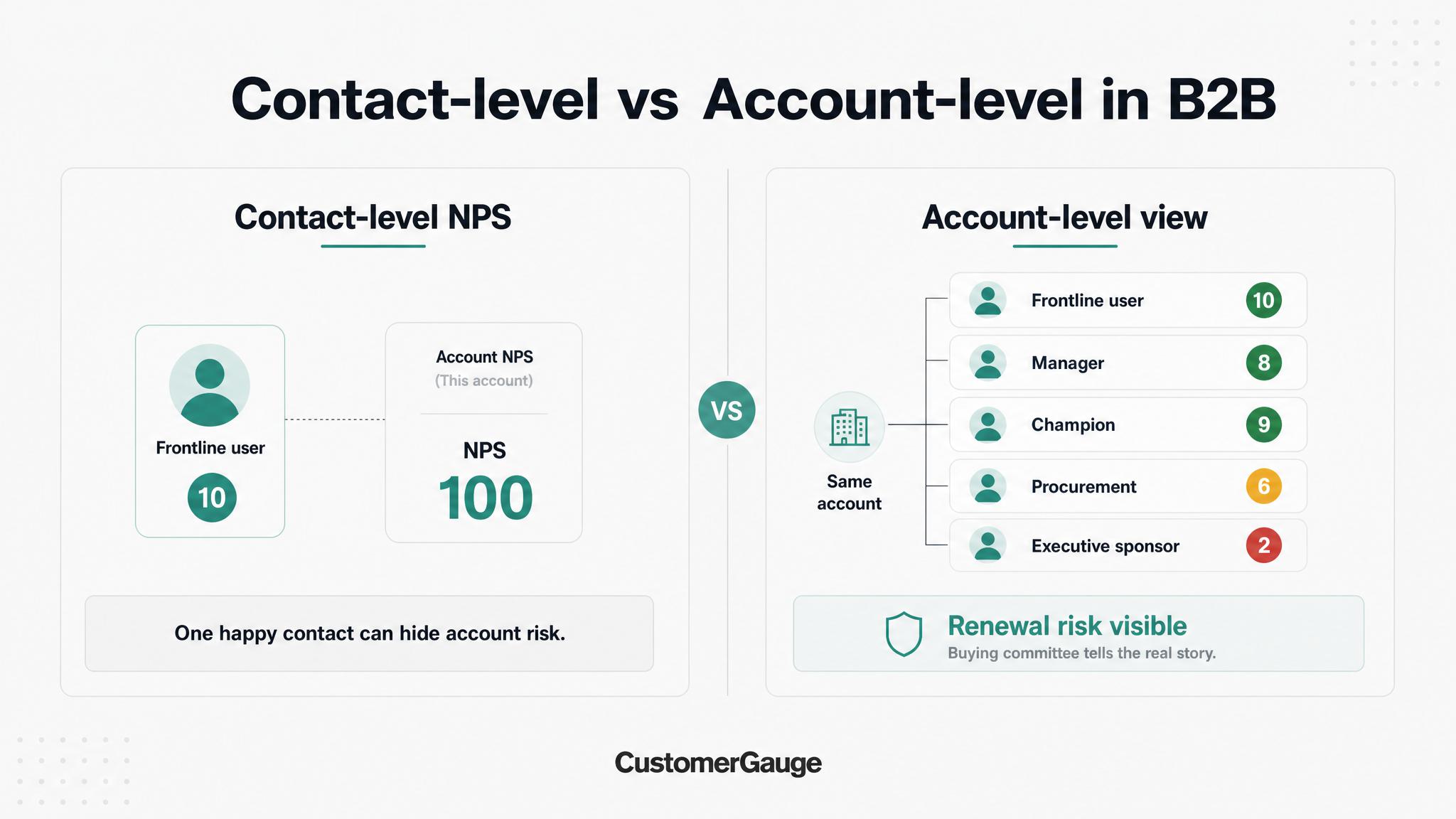
The reason is mechanical, not philosophical. In B2B, the customer is not a person, it is “people.” The customer is an account, and inside that account there are frontline users, middle managers, executive teams, an economic buyer, a champion, and a procurement function. Each of those “persons” has a different relationship with your product. Each of them carries a different amount of weight in the contract renewal decision. A buying committee in B2B is fundamentally not the same animal as an individual B2C respondent, and CX programs that treat them as the same return numbers with no clear referent.
The frontline-loves-you, executive-fires-you trap
The trap, in concrete terms: your frontline users could love your product. They use it every day, they have built workflows around it, they would give you a 10. But if the executive who signs the checks does not see value in what you are doing, that account will churn at renewal. The frontline NPS told you nothing.
Contact-level NPS, applied to an account-based revenue motion, obscures the entire landscape. You will earn (maybe) a single frontline respondent on a survey. They will score a 10. The dashboard will register the account at 100 NPS. Everything looks fine and dandy. Meanwhile you are missing 90% of the account sentiment, including whether the contract gets renewed. (Or not.)
The data fragmentation problem makes it worse
This is where most CX programs hit a wall they do not see coming.
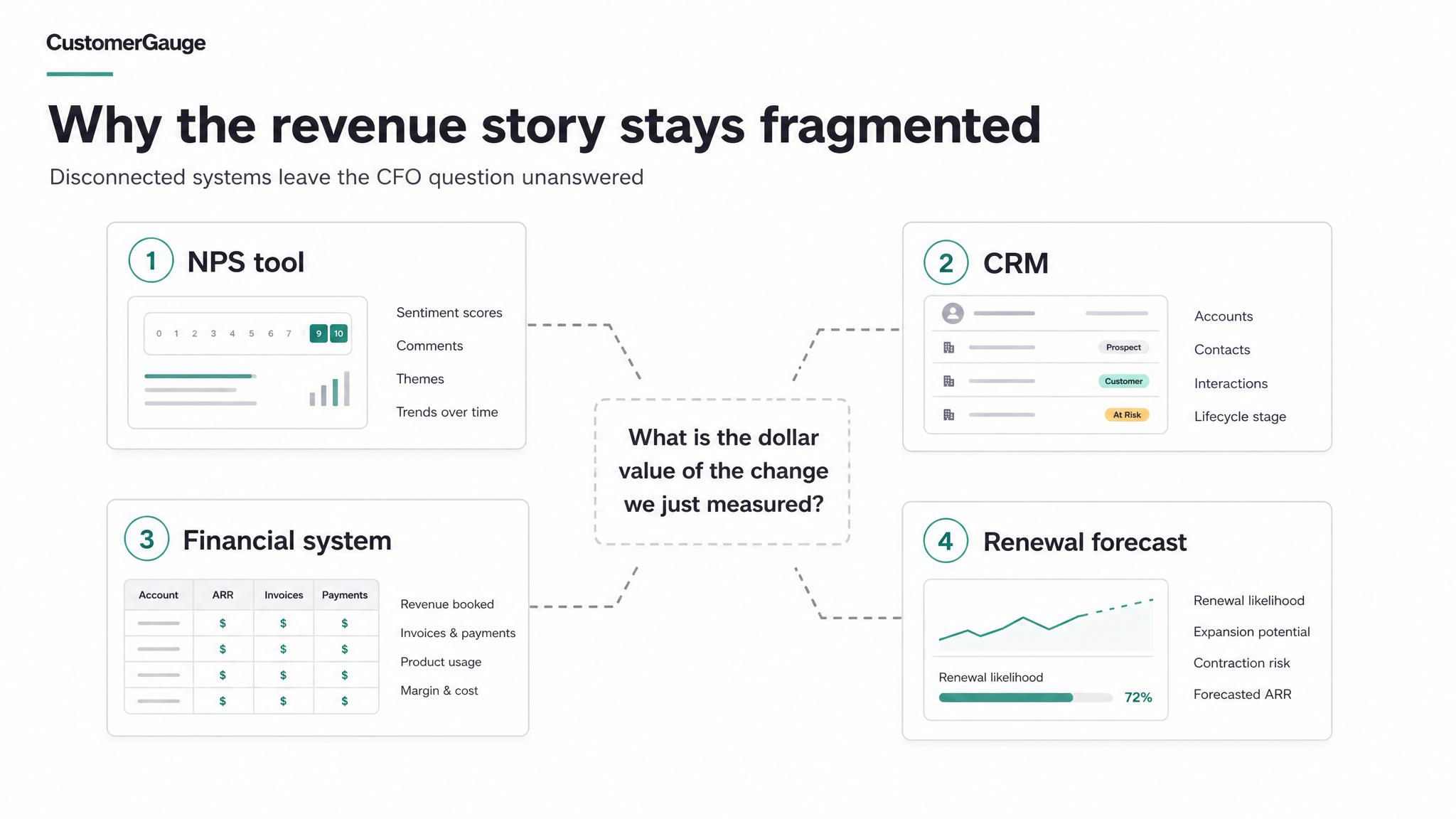
Your CFO cannot tell you what a contact-level NPS program is worth.
Ask a finance leader how a 7-point swing in NPS connects to revenue, and the honest answer is that it doesn’t, at least not in any meaningful way the program reports can surface. The score moves, the deck gets updated, the meeting ends. The dollars associated with that score live in a different system entirely, owned by a different team, on a different reporting cadence.
The data fragmentation problem is industry-wide. And don’t take our word for it.
A recent IBM study found that only 26% of organizations have their customer data primarily in Salesforce, and 53% identified poor data availability as the top barrier to extracting AI value from customer programs.
A standalone contact-level NPS tool sitting alongside a CRM, a financial system, and a renewal forecast adds another "deserted data island" to the chain. Each system can be queried individually, but nothing connects. And nothing in the chain answers the question every revenue-accountable executive eventually asks: what is the dollar value of the change we just measured?
What changes when NPS lives at the account level
When the primary unit of analysis is the ENTIRE ACCOUNT rather than the respondent, the program starts doing contextual work. A drop in account-level score precedes a renewal conversation rather than landing after the fact, when the contract is already canceled. Disagreement between stakeholders at the same account becomes a driving factor rather than drifting away into a meaningless composite. The score earns a dollar value because the underlying account ALREADY has one. The CFO question becomes answerable: a 10-point lift on accounts representing $4M in ARR is worth a specific, defensible, exportable number.
It also changes what “response rate” means. A contact-level tool reports the percentage of people who answered the survey. Useful, but it is a tool metric, not a business metric. The account-level question is different: how many of your accounts are actively engaged in giving you feedback, and how much of your revenue has the program actually captured? Call it engagement rather than response rate. A program with an 80 percent contact response rate that has never heard from a single one of its ten largest accounts does not have a strong program. It has a blind spot the size of its revenue. Engagement, measured at the account level, is the version of that number a CFO can read.
That is not a mere tool feature. It is a global methodology change. The Delighted sunset presents you with this rare opportunity for your B2B revenue team to make that change without having to justify pulling a working app to do it.
"Your frontline users could give you a 10. The dashboard could register the account at 100 NPS. Meanwhile you are missing 90% of the account sentiment, including the part that decides whether the contract gets re-signed."
What to Look for in a Replacement (B2B-Specific Evaluation Criteria)
For B2B teams choosing a Delighted replacement, the evaluation criteria that matter are not the same as the criteria most vendor comparison pages (read: “Dr. Internet”) emphasize. Survey templating depth, channel breadth, and response-rate optimization are real features, but they are not the features that distinguish a contact-level tool from an account-level platform. Five criteria do:
Account-level vs contact-level survey distribution
Can the platform distribute surveys to multiple stakeholders at a single account, and then aggregate responses at the account level rather than only at the respondent level? This is the foundational question. A platform that distributes one survey per contact is a contact-level tool, regardless of what the "packaging" claims. A platform that natively models accounts as the unit of measurement is a different kind of product altogether.
Multi-stakeholder response handling and aggregation logic
When five stakeholders at one account respond with five different scores, what does the platform do with that data? Average them? Weight by role? Surface the divergence as a signal in its own right? The answer matters. A 60 NPS for an account where the purchaser scored 20 and the product champion scored 100 is not the same account as a 60 NPS where every stakeholder scored between 55 and 65. The platform's aggregation logic determines whether that distinction is visible to the user, and it's a crucial distinction!
Revenue and renewal data integration
Account-level NPS only becomes actionable when it can be tied to the dollar value of the account it measures. The question to ask in vendor evaluation: can the platform ingest revenue data, renewal date data, and contract value data, and then surface NPS scores against those fields? Or is revenue tied to NPS by an analyst, after the fact, in a spreadsheet? So many B2B firms miss on this.
Historical data migration capability
For teams with years of Delighted history, the platform's ability to preserve that data with fidelity is a significant criterion. The practical questions: does the migration preserve raw scores, free-text comments, timestamps, and respondent metadata? Or does it preserve summary statistics only? Does the historical data drive live reporting in the new platform, or does it sit as a static archive?
Reporting depth: dashboard layer vs analyst-ready data export
Some platforms are dashboard-first: pre-built views, limited drill-down, no native export of the underlying data. Others are analyst-ready: every field exportable, the dashboard is one view among many, and the data can be moved into a CFO's spreadsheet or a BI tool without friction. For B2B teams whose CX program reports into a revenue-accountable executive, the analyst-ready model is usually the better fit. The dashboard-first model is built for teams who consume CX data inside the CX tool, not B2B teams who need to integrate it elsewhere.
"A platform that natively models accounts as the unit of measurement is a different kind of product, regardless of what its packaging claims."
How AI Search Tools Are Citing the Delighted Sunset, and What About AI Search Itself?
B2B research is growing daily on AI and LLM platforms. The team that just learned Delighted is sunsetting did not, in many cases, learn it from a vendor announcement or an industry newsletter. They learned it from ChatGPT, Perplexity, or a Google AI Overview answering a query they typed an hour ago. The migration research is happening the same way. Which pages those AI tools cite when they answer the migration question determines, to a meaningful extent, which platforms land on a shortlist.
CustomerGauge has been a primary source on the B2B account experience question for over a decade. The work is original: an account-level NPS methodology built specifically for B2B revenue growth campaigns, customer benchmarking data across thousands of accounts, and a published body of research connecting CX programs to renewal and revenue outcomes. When AI tools cite sources on the B2B side of the Delighted migration question, the citations are pointing at primary work, not at aggregated commentary. (And a lot of them point at us, incidentally!)
The measurement of AI search citation is still in its infancy. There is no single tool that reliably tracks every citation across every LLM surface in real time, and the major platforms are not yet exposing the equivalent of a server log for AI Overview answers. The surface itself, though, is real. The traffic and the influence are real. The measurement will catch up, guaranteed.
"CustomerGauge has been a primary source on the B2B account experience question for over a decade. When AI tools cite sources on the B2B side of the Delighted migration question, the citations are pointing at primary work, not at aggregated commentary."
What Account Experience Actually Measures
CustomerGauge has argued the account-level case for over a decade. We did not build Account Experience as an add-on to a contact-level NPS. We built it because we saw B2B revenue teams collect mountains of data, spend a ton of money to collect said mountains, and end up with a misleading signal on both account health and the underlying state of the business. Decisions were made around companies that did not reflect the reality of the customer base. The tooling category as it existed could not surface the complete picture.
Account Experience was built to fix that. The methodology has four working components, each of which exists because contact-level platforms cannot provide it, ipso facto.
Account-level survey distribution
Account Experience treats the account as the unit of analysis from the first survey sent, not as an optional configuration on top of a respondent-first data model. Surveys are distributed across multiple stakeholders at each account by design. Frontline users, middle management, executive sponsors, and procurement contacts each receive the survey path appropriate to their role. The platform is built around a multifaceted account from the start.
Multi-stakeholder aggregation that surfaces disagreement
Account Experience surfaces stakeholder disagreement as a signal on its own rather than burying it in an account-level average. The platform flags the divergence, identifies which stakeholder roles carry the most renewal weight, and routes the right alert to the right account manager. The aggregation logic is built to make disagreement visible, because in B2B that disagreement is often the signal that matters most.
Revenue-tied analysis and CFO-ready reporting
Every account in the platform carries its dollar value. Every NPS movement is reportable against that dollar value. When a CFO asks what a 7-point swing in NPS is worth, the answer is a number tied to specific accounts at specific contract values, exportable as a CSV that drops cleanly into a finance team's existing models. The reporting layer was built for executives who report to revenue, not for analysts who consume CX data inside the CX tool.
Historical data import path for teams migrating from Delighted
Teams with years of accumulated Delighted data can import that data into CustomerGauge with the score, comment, timestamp, and respondent metadata preserved at full fidelity. The historical data becomes live data in the new platform, not a static archive. Year-over-year trend continuity is preserved across the migration, which matters for teams whose CX program reporting depends on multi-year trend visibility. Our migration team has done this work enough times that the process is documented, supported, and predictable.
For B2B teams leveraging the Delighted sunset as the moment to upgrade their underlying program rather than just swap out a tool, Account Experience is the operational shape of Option 3. Options 1 and 2 are mechanically simpler in the short term. The teams who take Option 3 tend to come out of the migration with a program that can finally answer the questions leadership has been asking from the jump.
"We did not build Account Experience as a product variation on contact-level NPS. We built it because we kept watching B2B revenue teams collect a ton of data, spend a ton of money to collect it, and end up with horrible signal that misled them on both account health and the underlying state of their business."
"Will my historical Delighted data become live, queryable, multi-year-trendable data in your platform, or will it sit as a static archive? The answer changes which platform fits."
Option 3 isn't just a strategy. It's a working platform.
Option 3 is not the right call for every team, and we will be the first to say so. If your feedback program is genuinely working at the contact level, Option 1 or Option 2 may serve you better, and a good migration conversation should surface that honestly. But if your revenue runs through accounts and your current measurement is not matching, the Delighted sunset is the moment to fix it rather than rehouse it. The next step is a 30-minute conversation about how account-level NPS, multi-stakeholder aggregation, and revenue-tied reporting actually work in production. We can walk through it on a live platform, against a use case that looks like yours.
Request a Demo.
About the Author