




- Your benchmark is no longer your competitor. "The bar isn't your competitor anymore. The bar is the last human who actually picked up the phone." In an AI-saturated world, the simple act of calling a customer has become a differentiator.
- Only 5% of companies close the outer loop. CustomerGauge research spanning 2007 to 2025 and 150 million data points shows that while nearly every B2B company collects customer feedback, only 5% ever go back to customers and tell them what changed because of it. That is not a capability gap. That is a choice gap.
- Non-responders are not busy. They are too polite to tell you the truth. One of the most practically useful shifts in how to think about survey silence. Those quiet accounts are not passively fine. They are passively gone.
- B2B churn is almost never about a bad product. It is about a relationship that got too thin. When your champion leaves and you have been operating through a single contact, you do not have one contact problem. According to the CustomerGauge framework, you effectively have forty account problems at once.
- SmartBear generated $6M in referrals at a 47% close rate by calling their promoters. Not emailing. Calling. Most CX programs are so focused on fixing detractors that they leave this entirely on the table.
The Human Premium: What It Is and Why It Matters Now
The premise is pointed: as AI automation floods business processes, the gap between companies that invest in real human moments and those that do not is widening every single quarter. CustomerGauge calls this gap the Human Premium.
The argument draws on two decades of B2B NPS data, real customer case studies, and a frustration that anyone who has spent 40 minutes in a phone tree will immediately recognize. But this is not a nostalgia piece about the good old days of handshake deals. It is a practical argument about what actually drives retention, referrals, and revenue in B2B today, and what AI genuinely cannot replace.
Why B2C Is Training Your B2B Buyers to Hate You
Start with something most B2B teams do not talk about openly: the habits of the consumer world are bleeding into enterprise customer management, and they are causing real damage.
The familiar B2C frustrations stack up fast: phone trees with eight menu options, chatbots that loop back to the same non-answer, surveys with no follow-up, retention offers that only come after you cancel. Anyone who has tried to reach a human at a major brand recently has lived every one of these.
The problem is that these patterns are being copy-pasted into B2B relationships. A generic support inbox with a 24-hour SLA reads the same as a phone tree to a customer spending six figures a year with you. An AI-drafted reply that misreads the issue lands the same as a chatbot loop. An NPS survey that disappears into a void is the B2B equivalent of a hotel feedback card that goes straight in the bin.
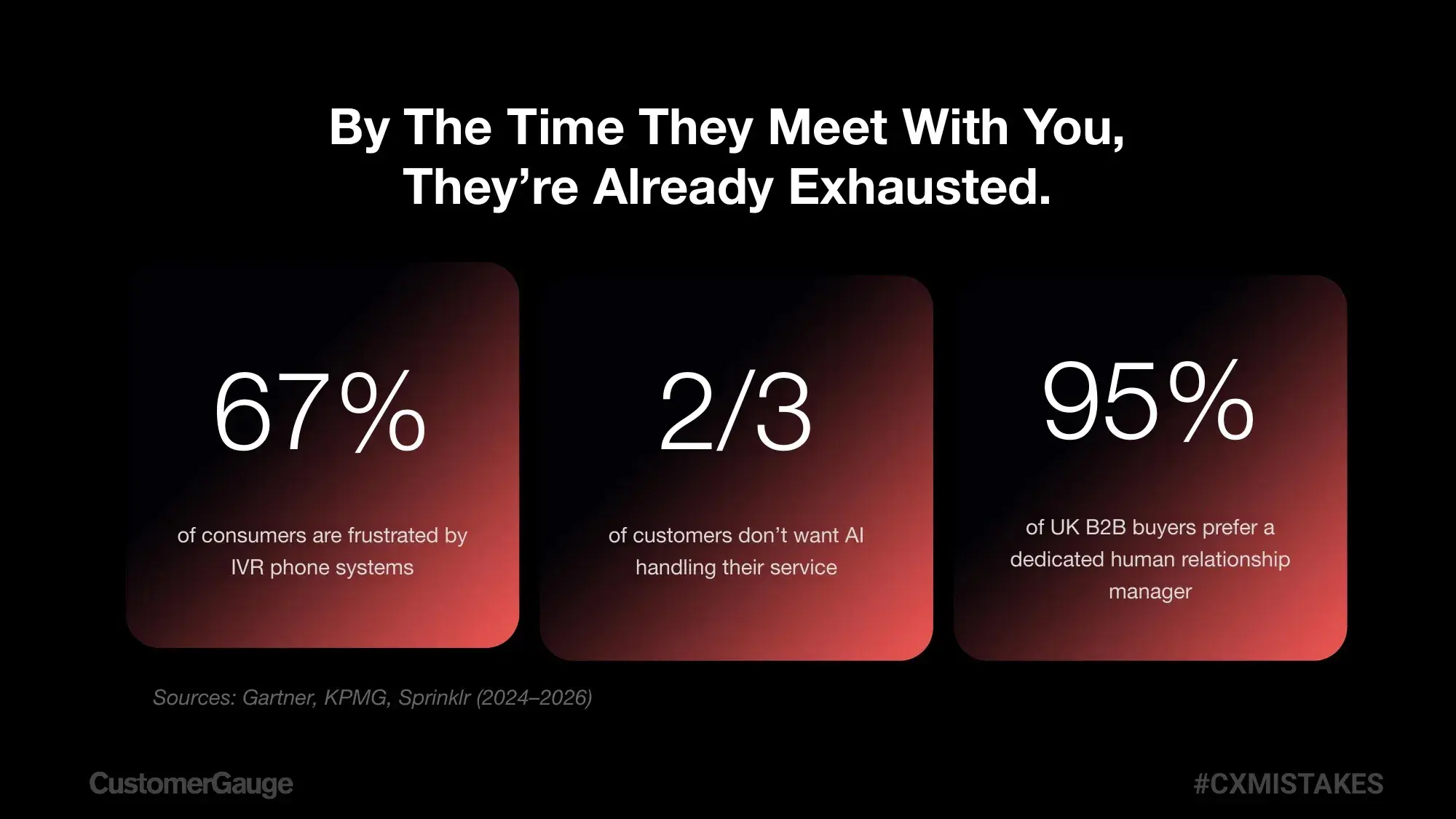
The numbers back this up. According to research from Gartner, KPMG, and Sprinklr (2024-2026), 67% of consumers are frustrated by IVR phone systems, two thirds of customers do not want AI handling their service, and 95% of UK B2B buyers prefer a dedicated human relationship manager. By the time your B2B buyers walk into a meeting with you, they have already had their patience worn down by the consumer world. The last thing they need is for you to repeat the experience.
The Human Premium: What the Data Actually Shows
The Human Premium is the gap between what an automated touchpoint is worth to a relationship and what a real human moment is worth. And the gap is widening.
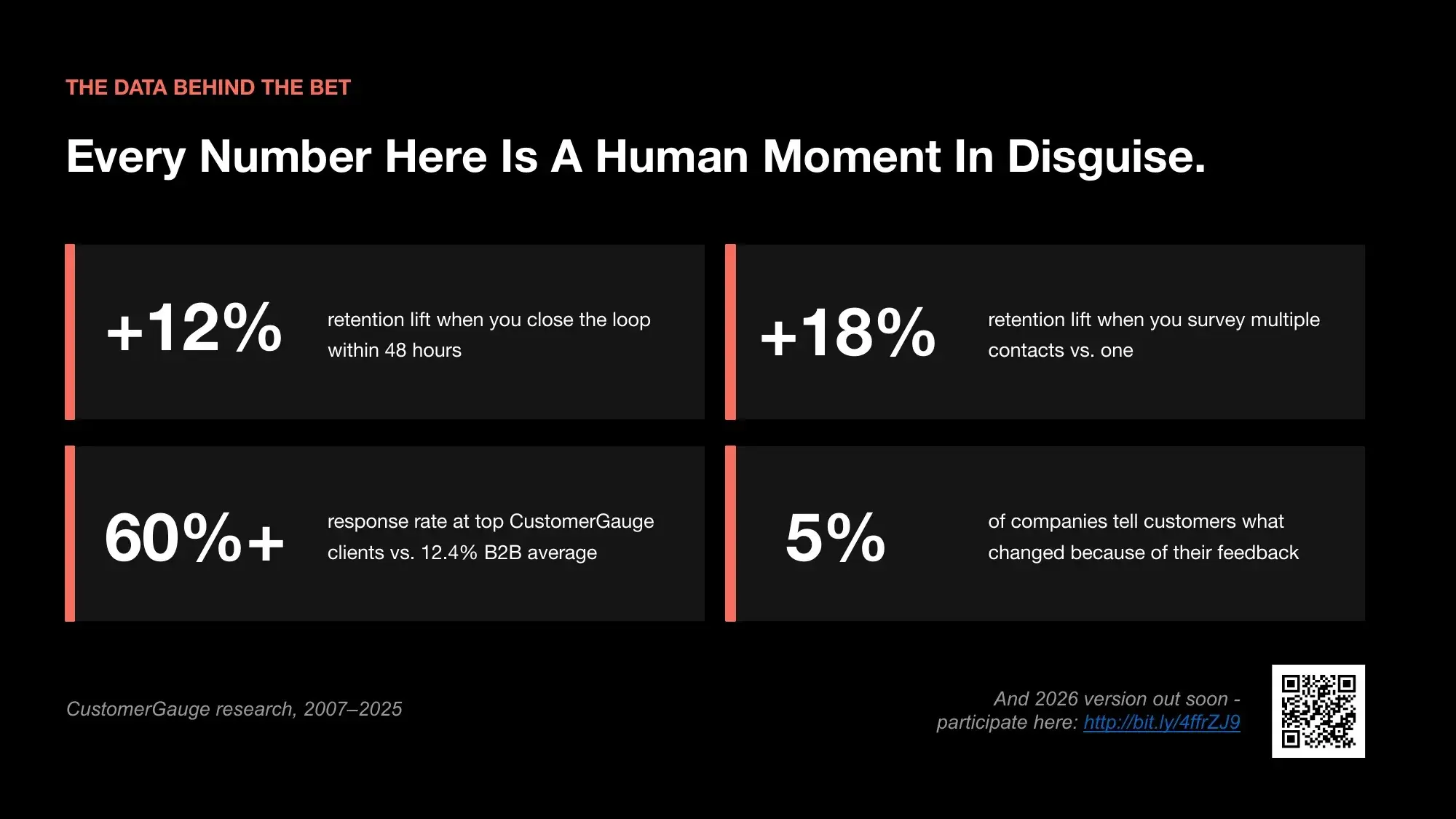
CustomerGauge's own research across nearly 20 years shows that closing the loop with a customer within 48 hours delivers a 12% retention lift. Surveying multiple contacts in an account rather than just one delivers an 18% retention lift. Top CustomerGauge clients achieve response rates above 60%, against a B2B average of 12.4%. And the outer loop, telling customers what actually changed because of their feedback, creates the moment when customers stop seeing you as a vendor and start seeing you as a partner.
The point worth sitting with is why the follow-up matters more than the survey itself. The survey is a request for someone's time and attention. The follow-up is the signal about whether their time was worth giving. Every account above a certain revenue threshold has five to ten senior stakeholders who have been watching how you treat their feedback for years. They remember which vendors called. They are already making decisions about the next contract based on those memories.
The 7 Human-First Plays
Seven concrete plays, inspired deliberately by the structure of "The 7 Habits of Highly Effective People." Each one follows the same shape: the mistake most teams are making, the human-first move, and the reason it works.
Play 1: Pick Up the Phone. Quickly.
When a detractor leaves a score of 4 and your CSM sends a thoughtful, well-crafted email within 48 hours, it still reads as automated. The account quietly disengages over the next nine months. The human-first move is a phone call from the most senior person available within 24 hours. Not a calendar invite. Not a template. A call that opens with: "I saw your feedback and wanted to hear it directly from you." The reason this works is that a phone call is a costly signal. Costly signals build trust faster than any volume of low-cost ones. Customers do not remember the resolution. They remember that someone called.
Play 2: Be Curious About What Is Behind the Score.
Treating an NPS 7 as a satisfactory answer and moving on is one of the most common and costly mistakes in B2B CX. The non-responders especially deserve attention. They are not too busy. They are too polite to tell you the truth on a survey. The human-first move is to treat every score and every silence as the start of a conversation. Ask what changed. Ask what almost made them leave. Ask what would make them rave to a peer. Vendors who ask better questions learn what their competitors will do next quarter six months before those competitors do.
Play 3: Build a Network. Never Accept a Single Point of Contact.
You survey your champion every quarter. They are happy. Then they get promoted, change roles, or leave. The new buyer has never heard of you. Renewal becomes a cold sales cycle. The human-first move for every account above your revenue threshold is to map at least ten contacts across three levels: C-suite, middle management, and frontline. For accounts above $100,000, you should be talking to at least six people. Above a million, nine is the benchmark. Track engagement gaps as a leading indicator of churn before the relationship actually breaks. The 18% retention lift from multi-contact surveying is one of the most reliable findings in CustomerGauge's dataset.
Play 4: Tell Customers What Their Feedback Actually Changed.
This is the one that only 5% of companies do, and it is the highest-ROI move available to most B2B CX programs. Once a quarter, the executive sponsor sends a personal note to affected customers: here is what you told us was broken, here is what we changed, here is the result. Then go further. Make it public. Make it a culture moment. Customer feedback shaping the roadmap should be a public ritual, not an internal slide. When your champion can forward that email to their boss and say "see, this is why we picked them," you have just done something no product feature can replicate.
Play 5: Put a Human at the Top of Every Major Account.
Your top accounts have a CSM. The CSM is excellent. But the customer's CFO has never spoken to anyone above your VP of Sales. When budgets tighten, you become a line item, not a relationship. The human-first move is a named executive sponsor on your side mapped to a named senior contact on theirs, with one face-to-face per year and one call per quarter. The sponsor's job is not to sell. It is to listen. The stat here is striking: 95% of UK B2B buyers say they prefer a dedicated human relationship manager. And real programs run on this model produce real numbers. SmartBear generated $6M in referrals through their executive sponsor program.
Play 6: The Classy Touch.
Celebrating a renewal with an automated email and a Salesforce stage change, or incentivizing survey responses with a $25 Amazon gift card, sends a signal. And not the signal you want. Senior B2B buyers do not fill out surveys for $25 cards. It reads as cheap. The human-first move is a handwritten note from the executive sponsor after a renewal, a go-live, or a promoter response. Real handwriting. Real signature. Mailed. For survey incentives, donate $5 per completed response to a charity in the respondent's name. Iron Mountain ran this model and lifted survey response rates by 30%, with the lift coming specifically from senior executives. Charity changes the question from "will you do this for us" to "will you let us do this with you."
Play 7: Do Not Forget Your Promoters.
Most CX programs are entirely focused on detractors. Promoters get a thank-you autoresponder, if anything. The result is that your best customers receive the least human contact, because nothing is on fire. The human-first move is a deliberate promoter program: personal thank-yous from the exec sponsor, early access to new features, advisory board invitations, and a clear ask for referrals made as easy as possible. Promoters drive 80% of referral revenue. Ignore them long enough and they become passive. Passive becomes detractor faster than most people expect.
Where AI Actually Helps You Be More Human
The argument here is not against AI. CustomerGauge is built on it. The question is where in the relationship AI belongs.
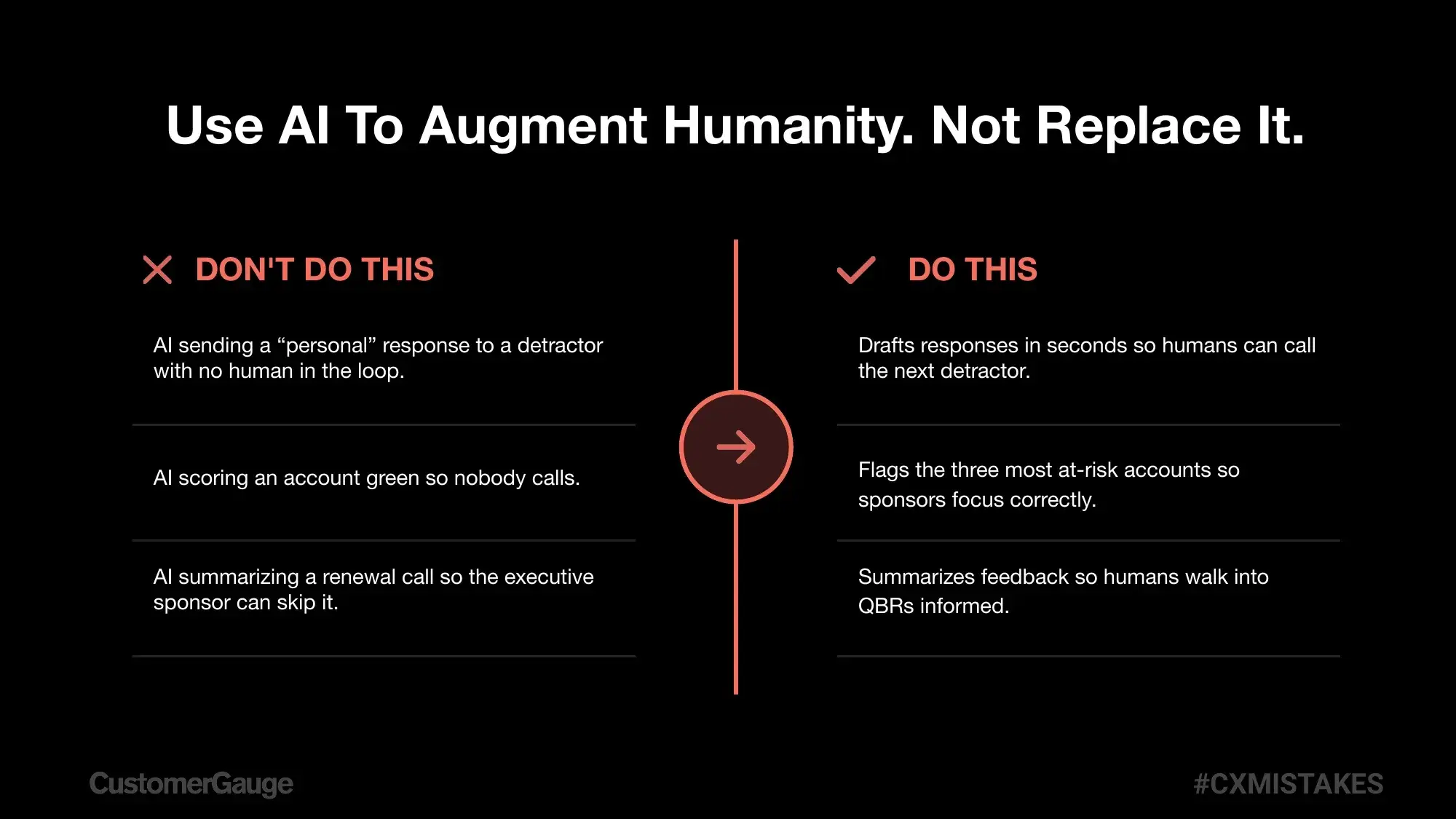
The distinction is straightforward. On the wrong side: AI sending a personal response to a detractor with no human in the loop, AI scoring an account green so nobody calls, AI summarizing a renewal call so the executive sponsor can skip it. On the right side: AI drafting responses in seconds so a human can call the next detractor faster, AI flagging the three most at-risk accounts so sponsors focus on the right ones, AI summarizing feedback so humans walk into QBRs fully informed.
The right frame here is "augmented human." AI's job is to make the humans in your organization more capable, more informed, and more present, not to replace the moments that actually build trust. CustomerGauge customers are already using Gaige to surface patterns in feedback data, generate first drafts of thank-you notes, and even script podcasts that communicate what the company learned from customers. The AI finds the insight. The human delivers the moment.
The 30-Day Human Premium Playbook
A four-week action plan, offered as a no-excuses starting point for anyone who wants to start closing the gap immediately.
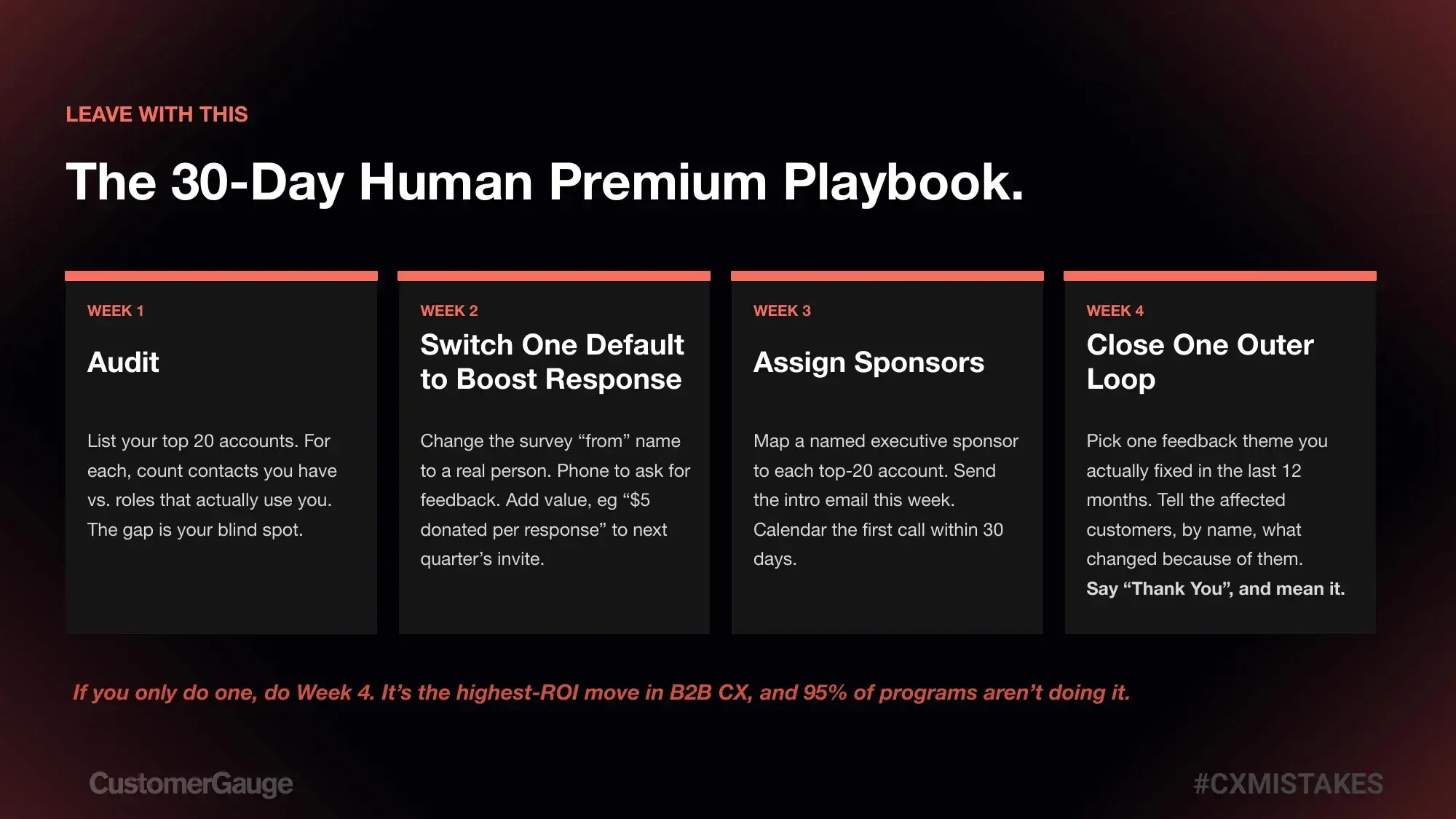
Week one is the audit. List your top 20 accounts. For each one, count the contacts you have against the roles that actually use your product. The gap is your blind spot. Fix it before anything else.
Week two is about switching one default to boost engagement. Change the survey "from" name to a real person. Pick up the phone to ask for feedback. Add a charitable donation element to the next survey invite. Make it look and feel human, because it should be.
Week three is about executive sponsors. Map a named sponsor to each of your top 20 accounts. Send the intro email this week. Get the first call in the calendar within 30 days.
Week four is the outer loop. Pick one feedback theme you actually acted on in the last 12 months. Tell the affected customers, by name, what changed. Say thank you and mean it.
If you only do one thing, do week four. It is the highest-ROI move in B2B CX and 95% of programs are not doing it.
The Real Point
In a world where AI can automate almost every touchpoint in a customer relationship, the companies that will win are the ones that make customers feel genuinely heard. Not processed. Not scored. Heard.
The bar is not your competitor anymore. The bar is the last human who picked up the phone.
Get Started With CustomerGauge
CustomerGauge is the B2B experience platform built for revenue-connected NPS, account-level feedback, and the kind of close-the-loop programs that actually move retention numbers. If you want to see how the plays above would work inside your program.
Request a Demo
Go Beyond the Help Desk
Underneath the mistake is a definition problem: treating AI CX as help-desk automation when the account is the unit that decides a renewal. We take that apart in AI customer experience beyond the help desk.
About the Author