



- NPS has always been a snapshot. Flight Paths turn it into a trajectory. Promoters, passives, and detractors describe a moment. Flight Paths connect every response an account or contact has ever given into one of six recognizable shapes, so you see the direction of the relationship, not just its current altitude.
- The Pull Up is the one that matters most. It is the account that was descending, got rescued, and climbed back to a score higher than where it started. Kahneman's Peak-End Rule explains why: people remember how the story ends, and a good recovery can outweigh the problem that caused it.
- Your B2B customers are not silent. Roughly 40% of respondents across the CustomerGauge client base are repeat responders, and they account for 60 to 70% of all responses. Individual contacts at larger accounts have given 10 to 12 responses over three years.
- Decline is operational. Recovery is human. When accounts slide, the comments talk about delays, friction, and process. When they come back, the comments name a person.
- Rescue Rate puts a dollar figure on a saved relationship. Because every account is tied to revenue, Flight Paths can show your board exactly how much revenue was pulled back from the edge. Flight Paths are live today on every account and contact page at no extra cost. The deeper analysis lives in Gaige.
Why Add New Words to Net Promoter?
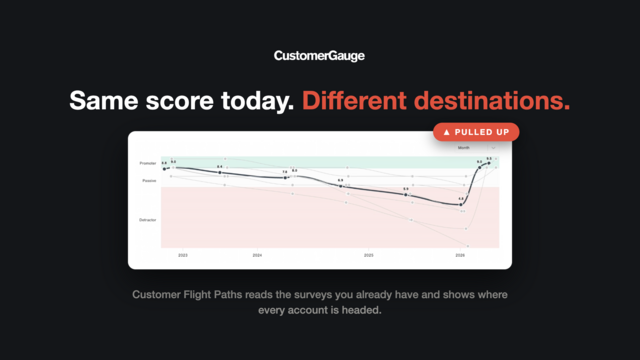
The webinar opened with two charts. The first showed a B2B account relationship sliding over several years. As Camilla Scholten put it, that looks like a customer at risk. The second showed the same downward slope, except something happened in 2026 and the line turned up.
That second chart is the whole reason for the launch.

Adam Dorrell framed it as adding to the vocabulary of Net Promoter. Promoters, detractors, and passives have served the industry well, but they are all snapshots. A customer responds, gets a score, and gets a label. When they respond again, that score is usually treated as another isolated measurement. Relationships do not work that way. They move. A flight path is where someone started with you and where they are now, and the shape of the line in between.
What Are the Six Customer Flight Paths?
Analyzed over time, every repeat responder's history forms one of six shapes.
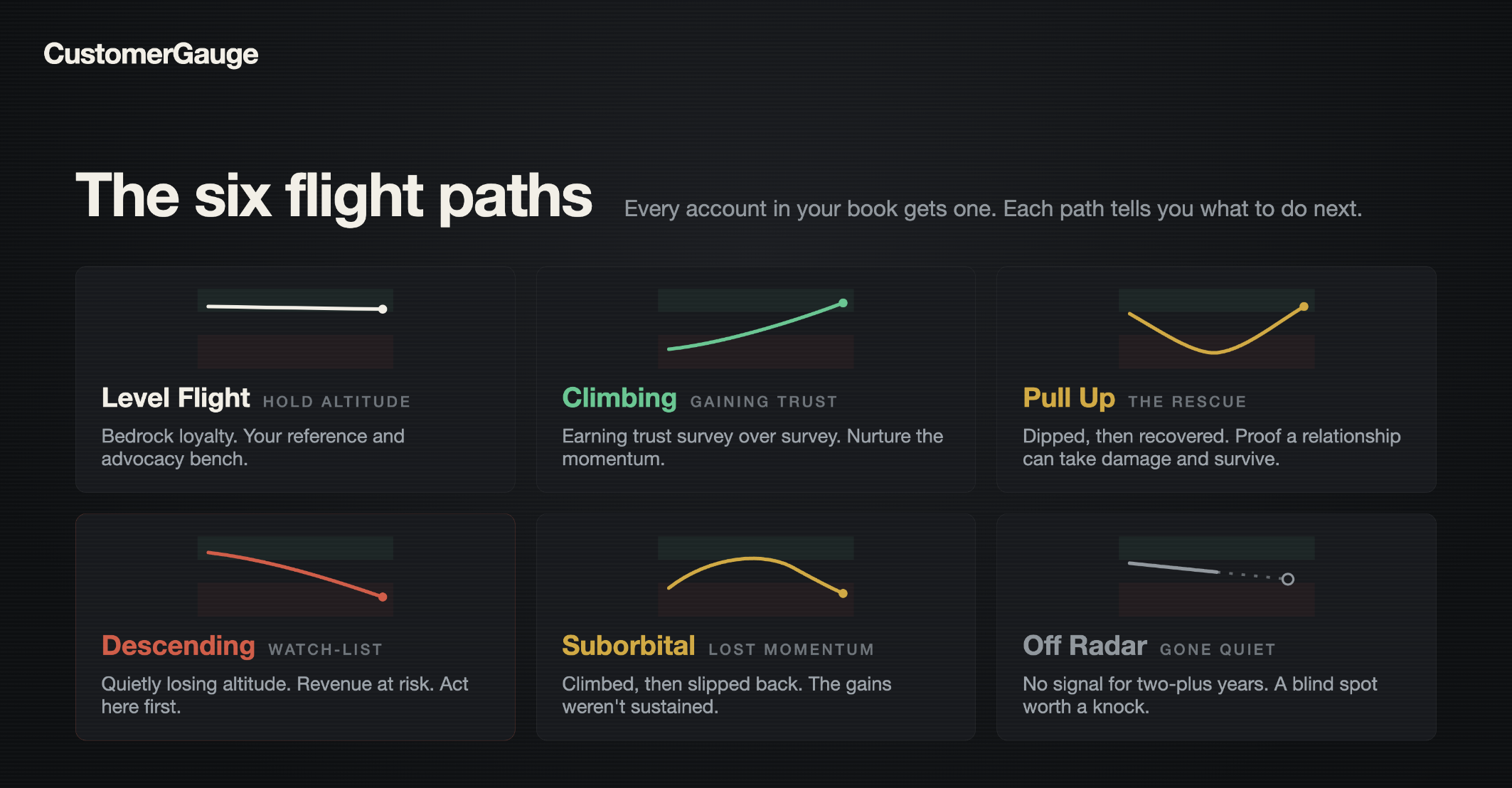
- Level Flight. A promoter who stays a promoter, year after year. Rare, and very good if you can get it. A detractor can also fly level, which is a different kind of problem.
- Climber. The relationship is improving. Each response comes in higher than the last.
- Descending. A gradual slide, promoter to passive to detractor over several responses. The customer is giving you time to fix it.
- Free Fall. A sudden drop from promoter straight to detractor. No warning, no glide. This is the urgent signal.
- Off Radar. A contact who used to give you feedback and has gone silent for two years.
- Pull Up. An account that was descending and recovered, often to a score higher than where it began. The most commercially important flight path of all.
Two things make the model more useful than it first appears. First, it runs at both the account and the contact level. An account is made up of people, and those people are on their own paths. Second, it is built from the customer's full response history, not from a single survey type or time window.
Why Is the Pull Up the Flight Path That Matters Most?
Trishaala Chengappa walked through a real account that had been giving feedback since 2023. It started in the promoter bucket, descended over the following years, and then in 2026 something changed. The account was pulled up, and ended above where it started.
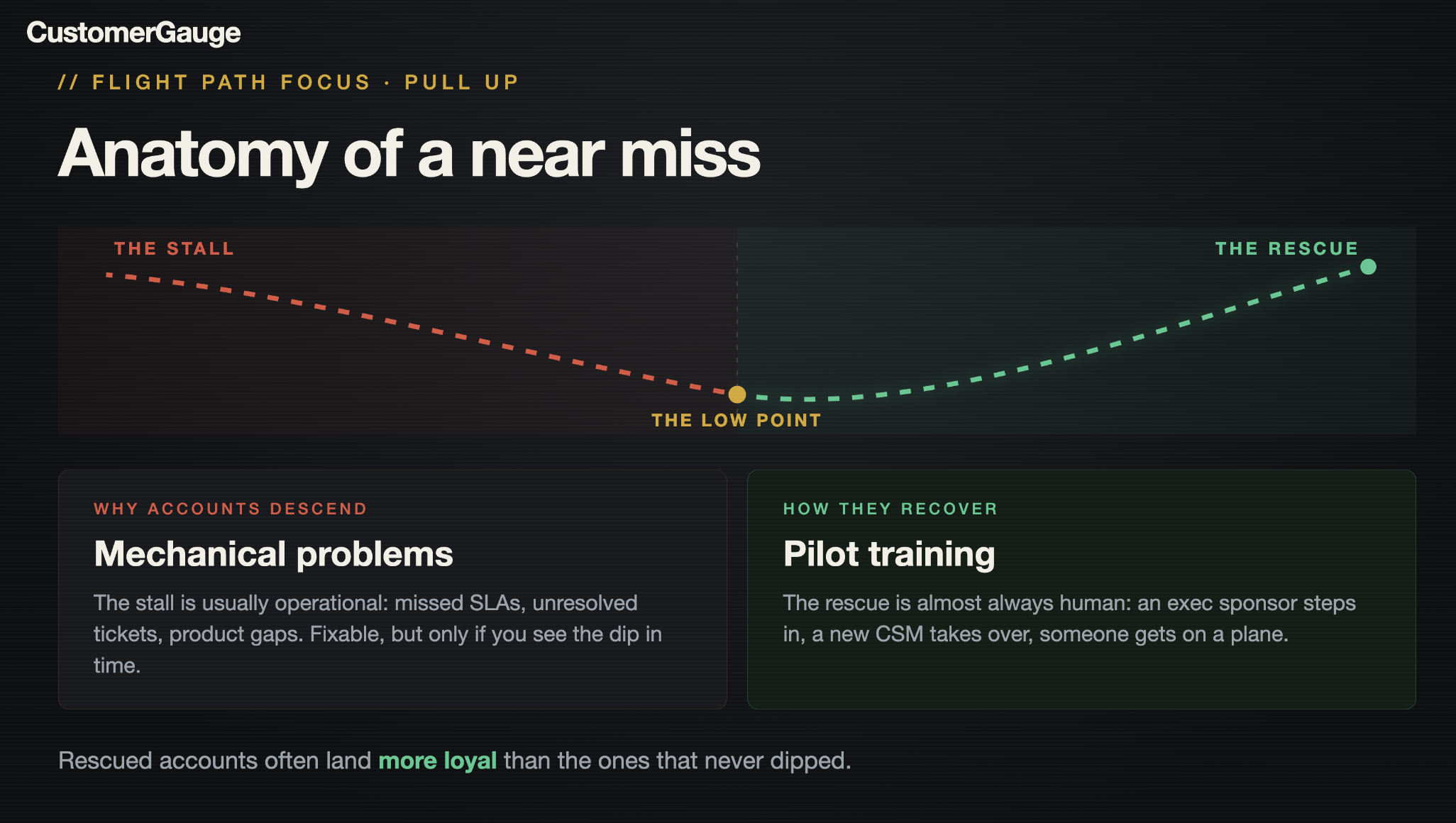
Zoom in and the account line turns out to be an average of several contacts, each with a distinct trajectory. Some were pulled up alongside the account. Some were stable detractors. Some were still descending. For an account manager preparing for a QBR, that view means never being blindsided again, and seeing the signals while they are still forming rather than after the renewal conversation has gone sideways.
Adam brought in Daniel Kahneman's Peak-End Rule to explain why the Pull Up carries so much weight. People remember an experience by its most intense moment and by how it ends. As humans, we tend to forget the bad stuff if the story finishes well. That is why a rescued customer often lands higher than a customer who never had a problem at all.
"You can end up with a higher score than you did at the beginning when you do a pull-up, and that's the thing that makes a relationship."
Hence the aviation metaphor. Nobody wants to be in a plane that is diving with no power. What everyone wants is for someone to pull up the stick.
The Myth of the Silent B2B Customer
None of this works unless customers respond more than once, and the assumption in most of B2B is that they do not. The data says otherwise.
Across the CustomerGauge client base, roughly 40% of all respondents are repeat responders, the same individuals answering year after year. That 40% accounts for 60 to 70% of the entire body of responses. Individual contacts at some of the larger accounts have given 10 to 12 responses over three years.
Adam admitted the number surprised the team. It also settles an old argument. B2B customers want to be heard over time. They are putting in the effort. The gap was never on their side. Until now, no CX platform was built to track what they were telling you longitudinally.
It is also why CustomerGauge keeps recommending that customers collect feedback from the same contacts two to three times a year. That cadence is what makes a flight path possible.
What Breaks Loyalty, and What Fixes It?
Once you can see the shapes, you can ask what causes them. Trishaala shared a pattern that showed up consistently, both in CustomerGauge's own data and in customer data during development.
The decline side is almost always operational. Delays, friction, process failures, the thing that took too long to schedule. The recovery side is almost always human. When rescued customers explain why they came back, they name a person. In the example on screen, named account managers appeared directly in the comments as the reason the relationship turned.
That pattern is the raw material for a playbook. Everything your account managers logged when they fixed the issue is sitting in your data. Gaige can mine it, so a single rescue does not stay a single rescue. You learn from it, template it, and deploy it across the base.
The same logic applies at the other end. Level Flight accounts are worth studying too, because whatever you are doing for them is keeping them exactly where you want them.
Flight Paths in Action
After the studio segment, product managers Fabian van Nieuwmegen and Andrew Todtenkopf took the audience into the platform.
The first stop was a single click. From any dashboard in CustomerGauge, open an account or a contact and the flight path is right there at the top of the page. The demo account, Northmere, was a Pull Up. Its rolled-up timeline sat at the top in black, and the grey lines behind it were the individual contacts. Scroll down and each contact appears with its own flight path, some matching the account and some on their own course. As Andrew put it, the account is your average, but the contacts tell you the stories.
Next was the difference between Descending and Free Fall. Fabian was precise about it. Descending is a customer moving down through the stages one response at a time, which gives you room to intervene. Free Fall is a promoter who drops straight to detractor. That is the signal to jump on today.
Then a Descending account, Arden Shaw. Andrew's advice was to start with what the customer has already told you. The contact breakdown at the bottom of the page shows every response and its comment. One respondent, Tom, had started with positive promoter comments, then began flagging operational issues that grew more frustrated over time, culminating in a spreadsheet workaround and a detractor score. The customer had already written the fix. All that remained was to do it and turn him into a Pull Up.
The Pull Up itself came from a hospital account. Hovering over the low point showed a score of 2 and a comment about maintenance on MRI machines taking forever to schedule. The team acted on it. The same contact later returned a 9, saying they had been heard and now knew exactly who to call. The account score moved from 8.8 at the start of the relationship to 9.5 by the end.
Finally, the question CustomerGauge always asks: what is the Pull Up worth? Andrew opened Gaige and pulled the list of pulled-up accounts alongside the revenue each one carries. That is Rescue Rate, a view of how much revenue you saved by moving accounts from Descending back into promoter territory. It is the number you bring to your board, and it makes the value of the program obvious in a single glance.
Where Does Gaige Fit?
The account and contact page views are standard and already in your system. The deeper analysis runs through Gaige, CustomerGauge's AI analyst.
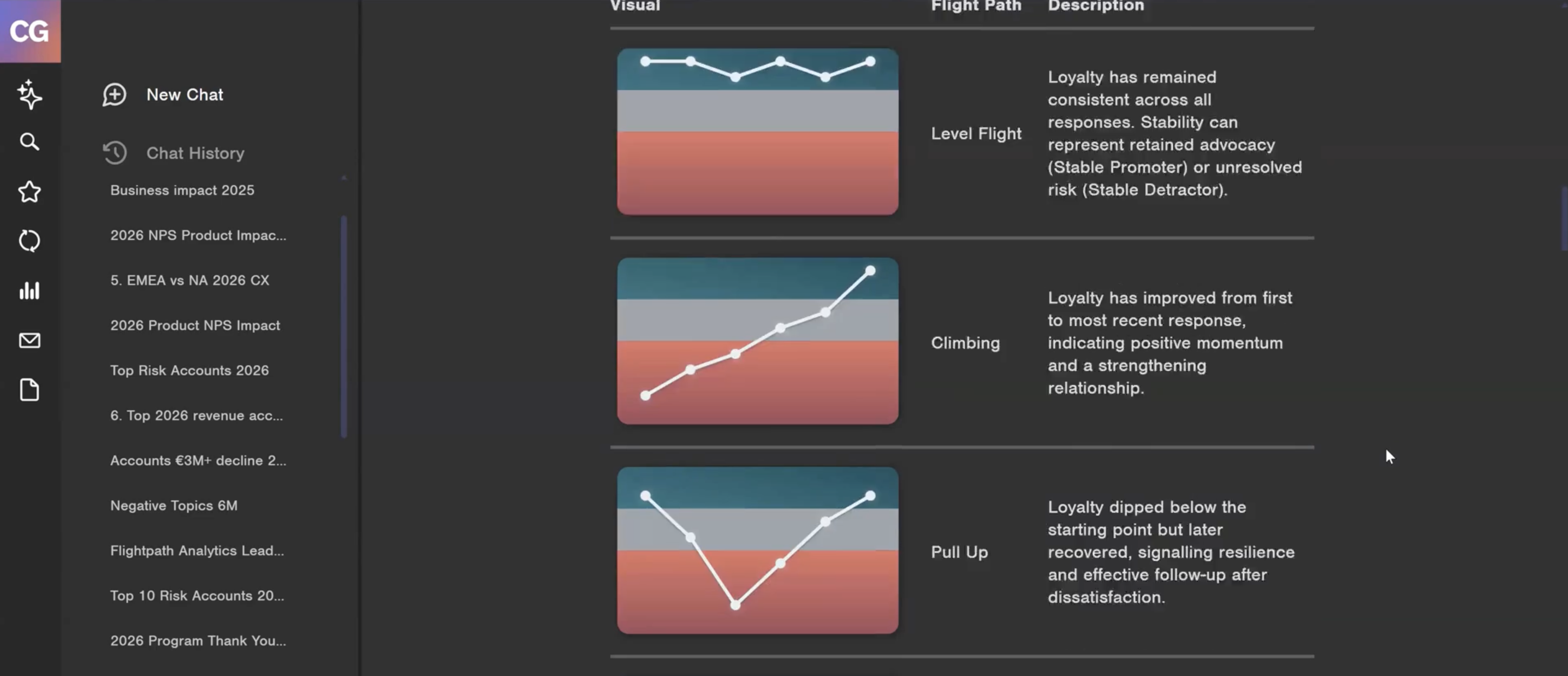
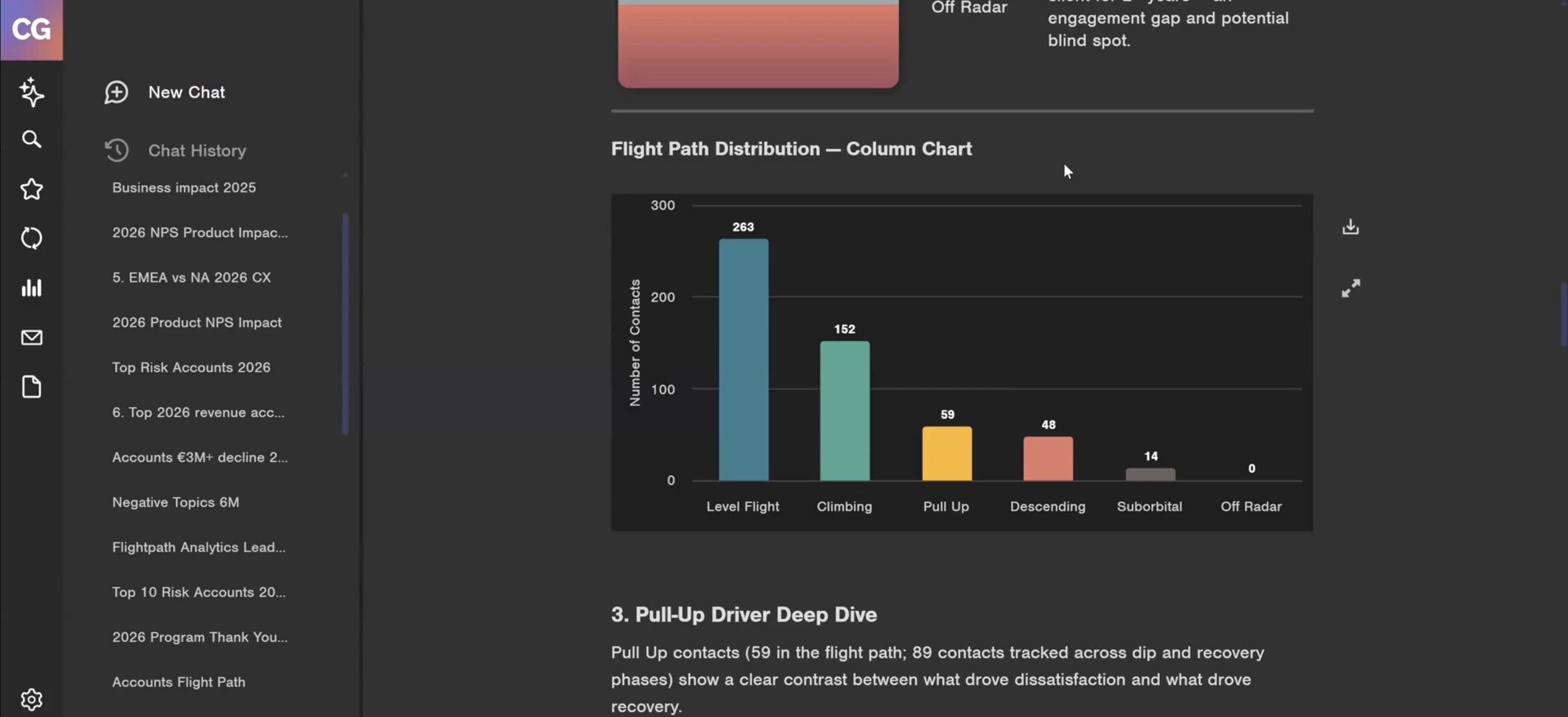
You can ask Gaige anything in plain language, from the reasons behind a dip to a revenue breakdown of every pulled-up account. But as Fabian noted, AI is only as powerful as its user, so the team also built a dedicated Flight Path Analysis skill. It works like an assisted guide. Pick accounts or contacts, add filters, choose a relationship touchpoint if you want one, and run it. Gaige comes back with repeat respondent counts, the spread of flight paths across your base, charts, and a reminder of what each flight path means. Segment by country, business unit, or a named set of accounts, and you have a map of where your whole customer base is flying.
What Should You Do First?
Adam had a concrete suggestion for anyone already on CustomerGauge. Look for the Off Radar contacts, the ones who used to respond and have not for two years. Go back to them and ask what happened. You have a reason to reach out, and you know from the data that they were willing to talk to you before.
Beyond that, focus the rescue effort on Descending and Free Fall accounts, because that is where revenue is walking out the door. Then study the Pull Ups you already have. Getting a Pull Up is a muscle, and the accounts you have already rescued are the ones that show you how to exercise it.
The industry has spent two decades telling companies who is happy right now. Flight Paths tell you where the relationship is headed.
The only question left is which way yours are flying.
Get Started With CustomerGauge
CustomerGauge is the B2B experience platform built for revenue-connected NPS, account-level feedback, and close-the-loop programs that actually move retention. If you want to see the flight paths inside your own customer base, and what your Rescue Rate looks like, the team is happy to show you.
Request a Demo
Existing customers: Flight Paths are already live in your account. Reach out to your Success Account Manager if you want help getting the most from them.
Go Beyond the Snapshot
Flight Paths tell you where a relationship is headed based on what customers chose to tell you. Signal Intelligence hears what they told you anyway. Together they close the gap between the survey and the account. Read From Surveys to Signals: The B2B Account Experience Agent Ecosystem for the other half of the story.
About the Author