


Customer service focuses on helping customers resolve individual questions or problems, while customer experience reflects the customer's overall relationship with the company. Customer service is only one aspect of customer experience. In B2B, that relationship belongs to an account with many people in it, so experience is measured account by account.
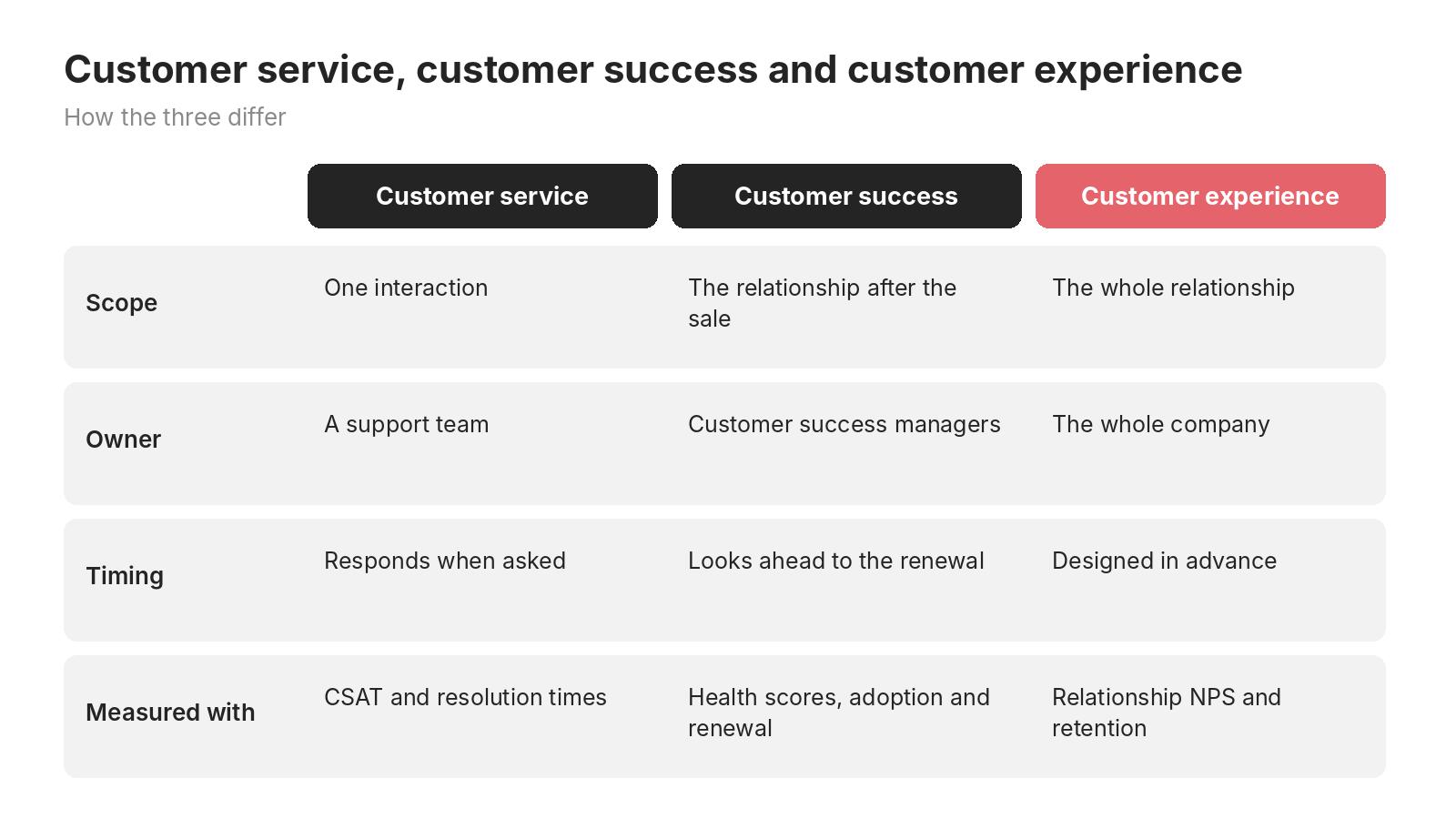
- Customer service is transactional, and often reactive. It handles one question or problem at a time, usually after the customer reaches out. Customer experience is the whole relationship, from the first sales call to the renewal, and is generally proactive.
- Great customer service does not always add up to a great customer experience. A support team can post excellent CSAT scores while the account decides not to renew.
- Customer success manages the relationship after the sale, mostly in SaaS companies. It is the term most comparisons leave out.
- Customer service is measured through individual interactions, usually with CSAT. Customer experience is measured across the broader relationship using relationship NPS and retention rates.
- In B2B, the customer is an account with many people in it, so experience is analyzed at the account level and weighed by revenue.
What is customer service?
Customer service is the support or guidance offered when a customer needs help, such as a question about an invoice, an issue with a product, a return or a change to their account. It is transactional by nature, with the support team taking ownership and handling each request from start to finish.
Most customer service is reactive; it typically begins when the customer reaches out with a problem or concern. The team's primary focus is to resolve the issue quickly, accurately and graciously. Although support teams generally handle customer requests on an individual basis, high-performing teams also spot patterns in customer requests and complaints that might point to a broader issue in need of attention.
Because service is delivered one request at a time, success is often measured by how satisfied customers are with each interaction. A common metric is the Customer Satisfaction Score (CSAT), which measures how satisfied customers were with the support they received, usually through a short survey sent when the ticket closes.
Customer service can occur via phone, email and live chat, and self-service options are becoming more prominent. Customers who use self-service help centers can find the answer they need before opening a ticket.
In B2B, however, there is an important distinction: the people who open support tickets are often not the people who sign the contract. A support agent can delight the user who called in without ever interacting with the executive who decides whether to renew. Good customer service matters, but it is only one part of a much larger customer relationship.
What is customer experience?
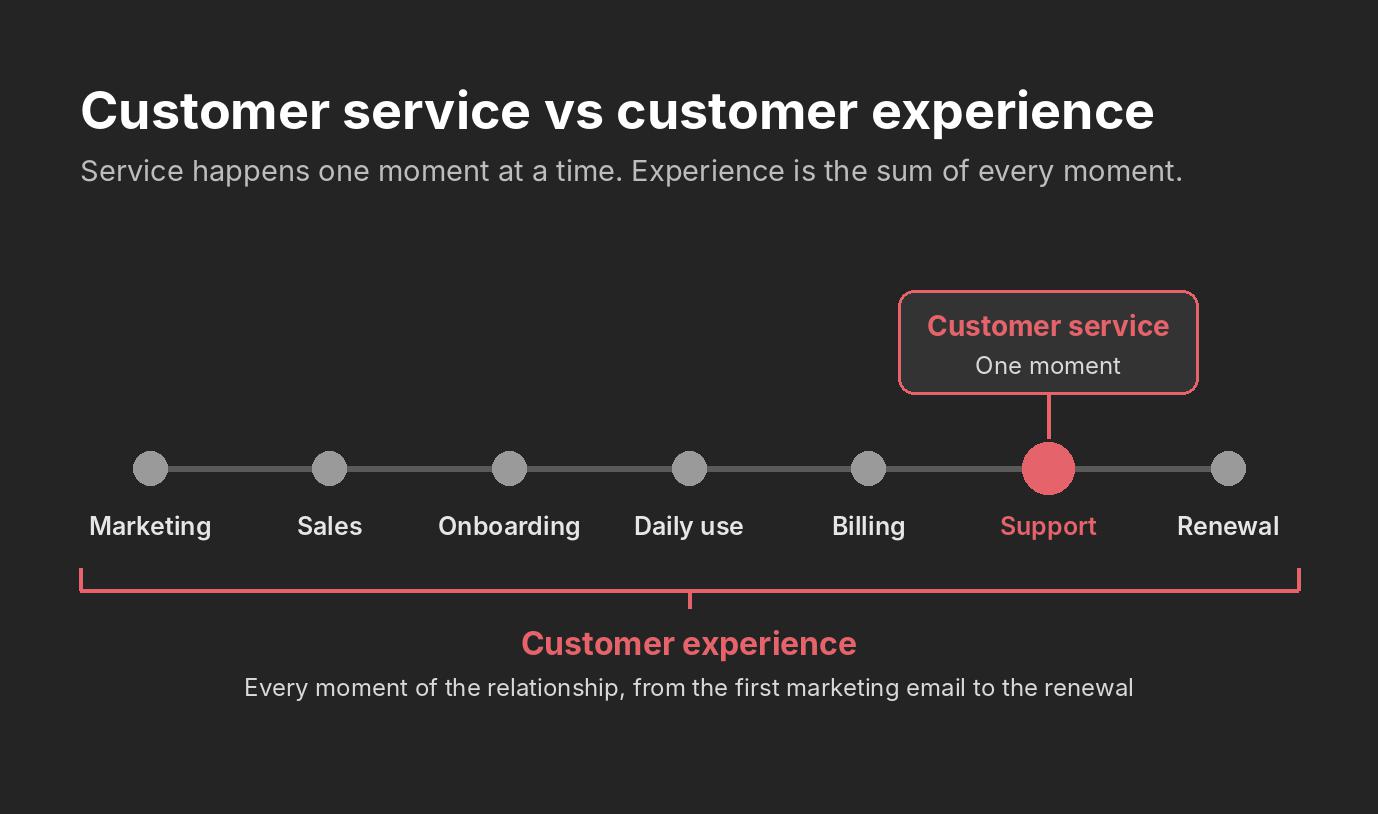
Put simply, customer experience is the overall relationship the customer has with your company. It includes everything from the first marketing email through the sales process, onboarding, daily use of the product, invoices and billing, support and the renewal conversation. Every one of those moments shapes how the customer feels about doing business with you. Experience also covers the stretches when there are no issues to address: how straightforward the billing process is, how easy the product is to use and how often someone checks in without being asked.
Where customer service is transactional, customer experience is relational. The goal is to build trust and loyalty, turning detractors into promoters and opening opportunities for upselling and referrals. A customer who trusts the relationship will buy more and tell their peers about it; a customer who merely tolerates it may be at risk of churn.
Customer experience is, unlike customer service, generally proactive. Nobody waits for a complaint before deciding how onboarding works or how renewals are handled. No single team owns it either: marketing, sales, product, finance and support all contribute, which is why mapping the journey across every touchpoint matters.
Companies that run the experience as a structured program call the practice customer experience management (CXM). It involves collecting customer feedback, identifying areas for improvement and working across teams to strengthen the overall customer experience. For a deeper read on how the work changes when the customer is another business, see our guide to B2B customer experience.
For a closer look at CX in practice, explore four B2B customer experience success stories from IBM, FedEx, GE and Nationwide.
How does customer service differ from customer experience?
Customer service is just one piece of the larger customer experience. Service happens one moment at a time, while experience is the sum of every moment, including the many that never reach a support queue.
The two differ on five points:
- Scope: Service focuses on a single interaction; experience encompasses the whole relationship.
- Timing: Service is the response to a customer's request for help; experience can be planned and managed in advance.
- Ownership: Support teams are responsible for service; customer experience involves the entire organization.
- Time horizon: Service interactions play out over minutes or days; experience develops over months and years.
- Measurement: Service is measured through transactional CSAT surveys; experience is tracked using relationship NPS and retention metrics.
Excellent customer service can mask problems with the broader customer experience. A support team can resolve every ticket quickly and courteously while the customer grows tired of needing to open tickets at all. Good service alone does not make up for an overall poor experience.
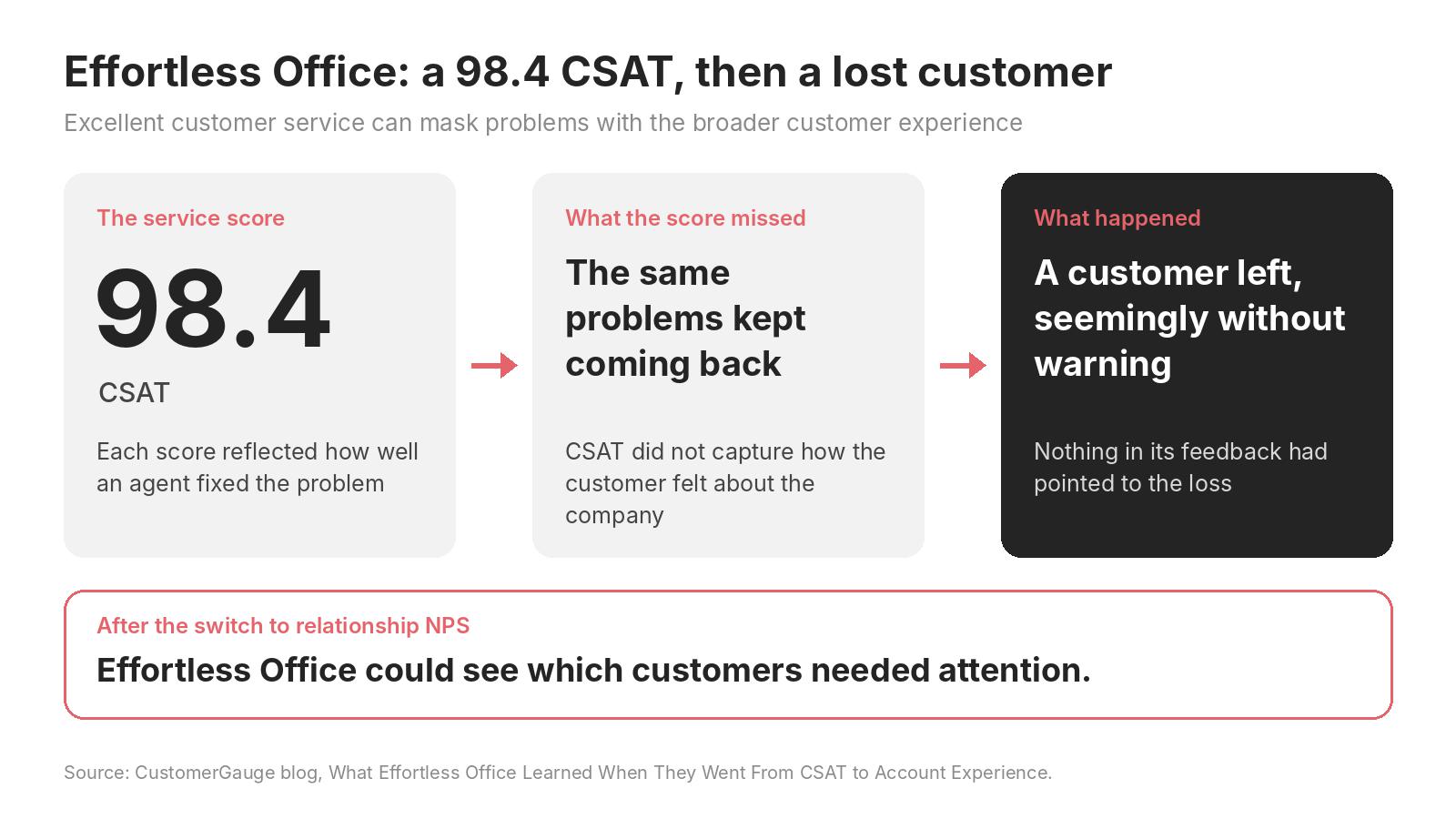
Take, for example, Effortless Office, a CustomerGauge customer that learned this the hard way. Effortless Office ran transactional CSAT surveys and held a CSAT of 98.4. Although these scores reflected how well an agent fixed each problem, they did not capture how the customer felt about the company, and the same problems kept coming back. Then Effortless Office lost a customer, seemingly without warning. Nothing in its feedback had pointed to the loss, and the account team was caught off guard.
After the switch to relationship NPS surveys, Effortless Office launched its program in 4 days and recorded a first NPS of 44. Even better, it could now see which customers needed attention.
So which matters more? Both customer service and customer experience play important roles, but it is the customer experience that determines whether a customer stays. Service is simply one of the moments that shapes it. A company that watches only its service scores cannot see retention risk coming.
What is the difference between customer success and customer experience?
Customer success is the work a company does to help customers succeed after the sale, from onboarding and adoption through renewal and expansion. It is most common in SaaS companies, where customer success managers track each account with a health score and step in when usage or engagement drops.
While customer service usually responds to problems when they arise, customer success looks ahead. A customer success manager typically reaches out before a renewal to make sure the customer is getting value from the product. A support agent, by contrast, waits for the customer to report a problem, then solves it.
Customer experience expands beyond both these approaches. It includes everything an account encounters throughout the relationship, whether it is service, success, product, billing or sales. Customer success and customer service each contribute to that experience, but neither represents the full picture.
One point worth clarifying: CS is an abbreviation that can mean customer service in some companies and customer success in others. When two teams say "CS" in the same meeting, it helps to confirm which one they mean before anyone agrees on a goal.
For more information about how the discipline developed and what its teams measure, see our brief history of customer success.
How do you measure customer service and customer experience?
Each one is measured on its own terms, and confusing the two can leave companies surprised by a renewal they thought was safe.
As discussed above, customer service metrics are transactional:
- CSAT: Measures satisfaction after an interaction.
- First contact resolution: The percentage of issues resolved without a follow-up.
- Response and resolution times: Measure how quickly issues are addressed and resolved.
- Customer Effort Score: Measures how easy it was to get help.
Customer experience metrics follow the relationship as a whole:
- Relationship NPS: Measures loyalty to the company; it is asked of every contact in an account and read by role.
- Retention and churn: Track how many customers stay or leave.
- Net revenue retention (NRR): Revenue kept and grown from existing customers.
Customer success teams also track their own metrics, including health scores, product adoption, renewals and expansion.
None of these metrics is wrong. Each answers a different question: Was an interaction handled well? Is the customer getting value? Is the relationship growing or shrinking? Trouble starts when only one of them is asked to answer all three.
For a side-by-side look at the three survey metrics, see our comparison of NPS, CSAT and CES. For the measures that carry the most weight in B2B relationships, see which B2B experience metrics actually matter.
Our look at how customer satisfaction and retention correlate finds that the two generally go hand in hand. A high CSAT on support tickets, however, still does not mean that an account will renew. It records how one interaction went, scored by the person who had it, and that person may have no say in the renewal.
Why the difference matters more in B2B
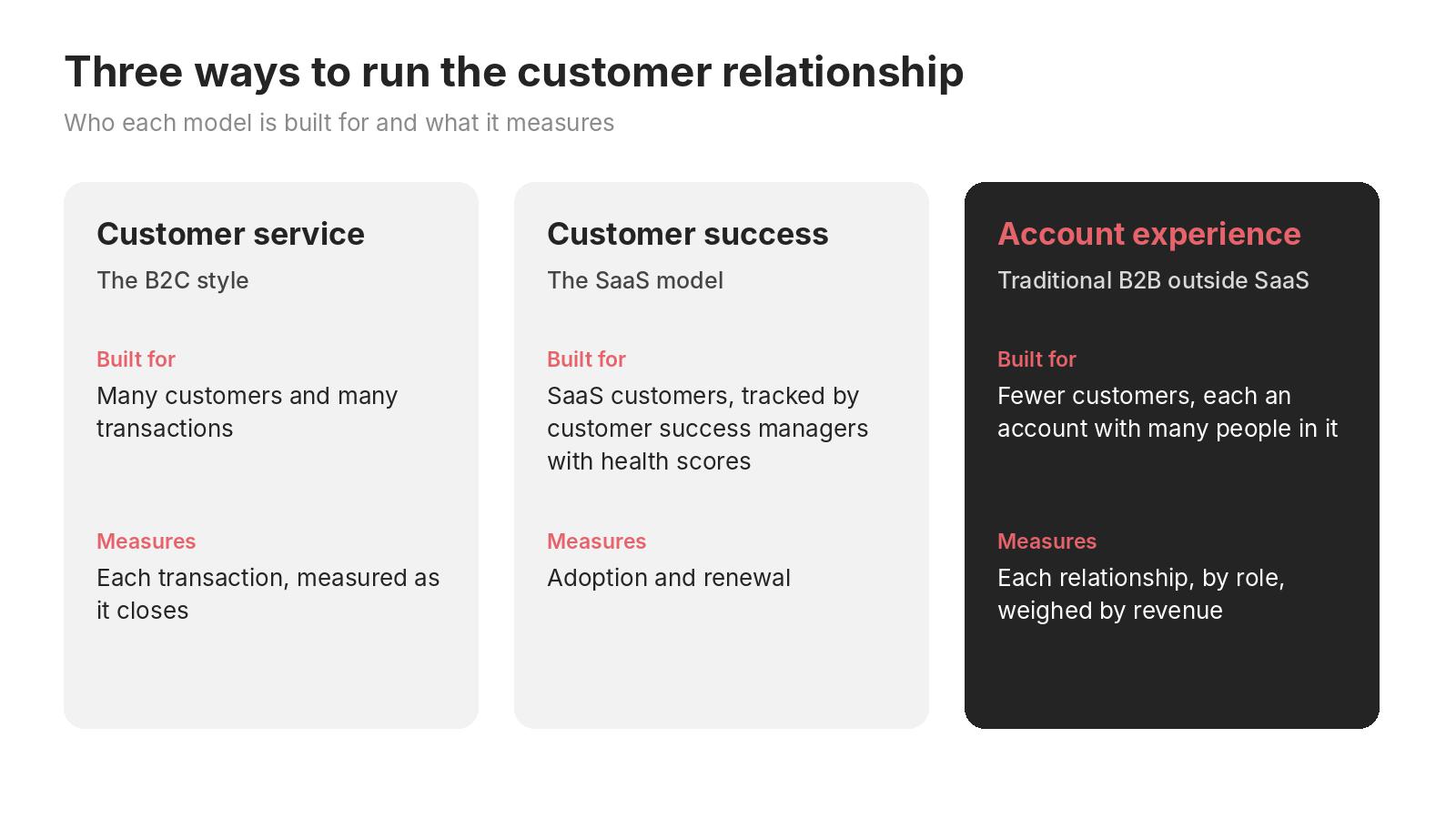
Companies tend to take three approaches to managing customer relationships:
- Customer service: Common in B2C, it involves a high volume of customers and transactions, with each interaction measured for satisfaction upon completion.
- Customer success: Common in SaaS, it relies on customer success managers who track account health scores, adoption and renewals.
- Account experience: Common in traditional B2B outside SaaS, where companies manage fewer customers, each an account with many contacts, and read feedback relationship by relationship.
Account experience starts from a simple fact: in B2B, the customer is not one person. It is an entire account: the users who open tickets, the managers who run the program and the executive who signs the renewal. Each of them sees a different part of your company, and each has their own perspective on it.
That is why customer service scores do not always tell the full story. The scores come from the users, so they do not reflect experience across the whole account. Users deal with support most often, but the renewal decision comes from the executive, who may never open a ticket. An account can rate every support interaction highly and still be sliding toward the exit, which is what happened at Effortless Office.
To better understand customer experience, companies need to consider each account, gather feedback across roles, weigh it by revenue and track changes over time. CustomerGauge's Account-Centric NPS brings feedback and revenue together at the account level, so teams can spot risk before it becomes churn.
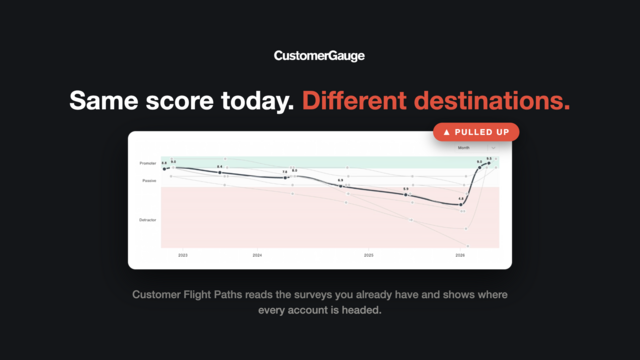
The same view can be applied to written feedback through customer sentiment analysis, read by account and by role. Because an account's relationship shifts over time, Customer Flight Paths describe the paths a B2B account can follow, beyond a single promoter or detractor score.
The business case shifts too: service metrics show how well a team handled demand, while account experience shows which revenue is safe and which is at risk.
How to improve customer service and customer experience together
Customer service and customer experience improve together when the teams behind them share what they learn. These five habits make the biggest difference:
- Send feedback to the team best equipped to address it, then close the loop with the customer so they know what changed.
- Give support, customer success and account teams the same view of each account, so a rising ticket count and a falling relationship score can be considered alongside each other.
- Look beyond individual support tickets to identify the root cause behind them. Solving the same issue repeatedly signals a product or process problem.
- Gather feedback beyond the support ticket. Ask every contact in an account about their experience, not just the people who requested support.
- Measure each team on its own performance, with everyone sharing responsibility for retention and revenue goals.
None of this replaces good customer service. It gives service and account teams a shared understanding of each account.
About the Author