




Quick answer: what is AI customer experience?
AI customer experience (AI CX) is the use of artificial intelligence to improve how customers experience a company across the full journey: support, feedback, product usage, and account relationships. For B2B companies, effective AI CX connects feedback and account signals directly to revenue and retention, versus stopping at chatbots and automated tickets.
What is AI customer experience?
AI customer experience, usually shortened to AI CX, is the application of artificial intelligence to the company’s understanding of its customers and customer service. It covers the entire relationship broadly. Support conversations, survey responses, product usage, contract renewal risk, and the account relationship itself all produce actionable signals. AI CX is what a company does when it uses machine learning to read and interpret those signals, then act on them.
The term “AI CX” can be used narrowly or broadly.
The narrow use means customer service automation, usually chatbots that answer common questions. Or routing that sends a ticket to the right queue. Suggested replies that let an agent respond in half the time. Most companies start there, and this article treats it as legitimate rather than as a straw man.
The broader usage applies AI everywhere the customer leaves a trace, including outside of support tickets. A renewal conversation is customer experience. A quarterly business review is customer experience. A survey response that nobody ever read is customer experience (and so is the churn that follows it)!
For B2B companies the broad definition is the relevant one, and the reason is structural versus philosophical. A B2C firm may serve millions of individuals whose value is measured one transaction at a time. B2B companies may serve a few hundred accounts whose value is measured in contracts. When one of those accounts leaves, the company has not lost a sale. It has lost a line item, and often a reference, and sometimes even an entire category.
Which definition of “AI CX” a company adopts is not academic. It can drive where budget goes, which team owns the initiative, and what gets reported at the end of the year. A company that defines AI CX as support automation will staff it from support, fund it from the service budget, and measure it in tickets. A company that defines it as account intelligence will staff it, fund it, and measure it in terms of retained and expanded revenue. Both companies will tell their boards they invested in “AI customer experience.” Two very different flavors, however.
What AI customer experience covers
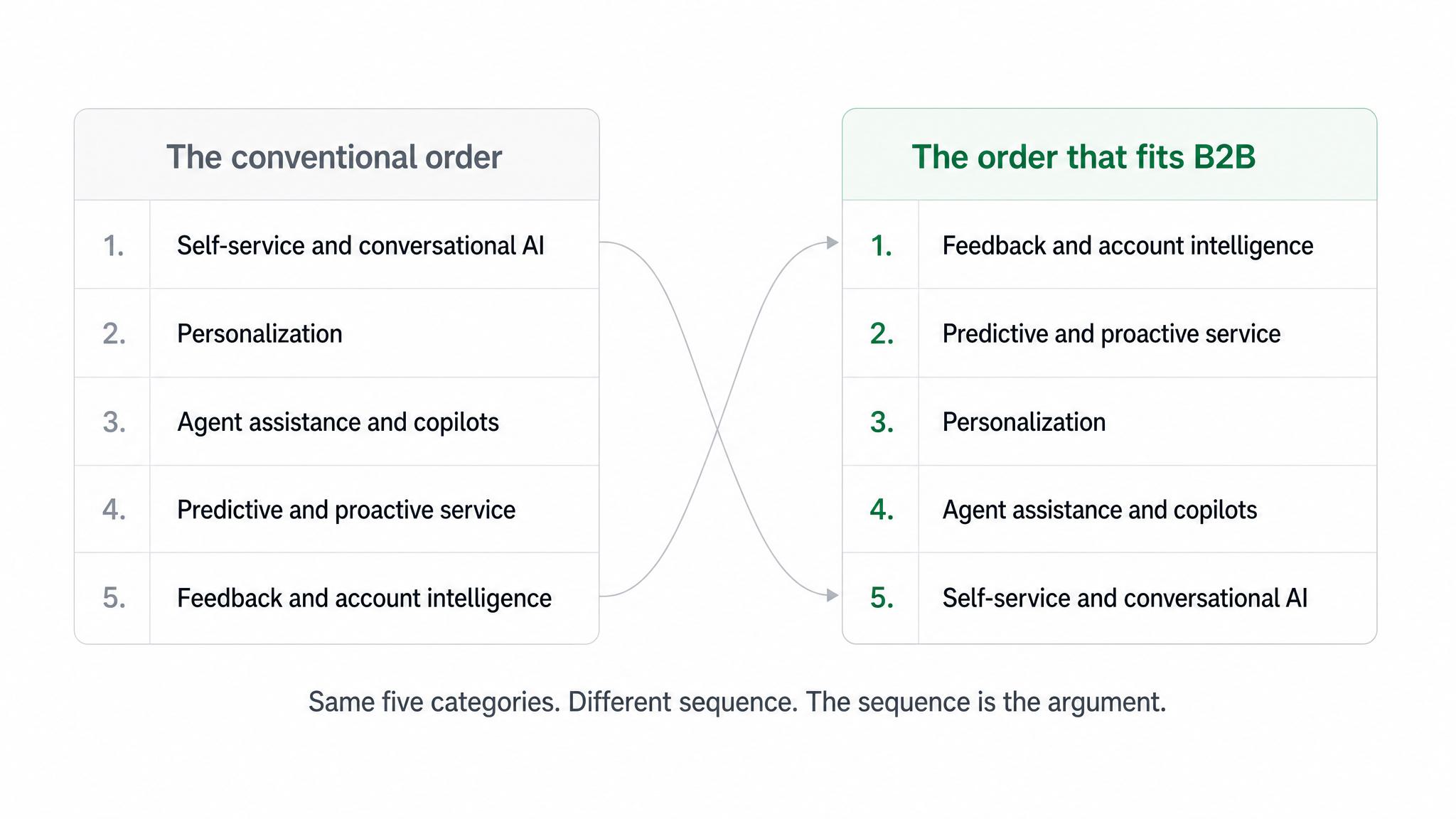
Most descriptions of AI CX map the same territory. Conventionally:
Self-service and conversational AI
This is the most visible category and the one most people imagine first. Chatbots and virtual assistants handle repeat questions without a queue. Intelligent routing reads an incoming message and sends it to the team most likely to resolve it. Knowledge bases surface the right article instead of forcing the customer to hunt and peck for it.
Applied well, this removes friction from routine questions that don’t require a human agent. Applied badly, it becomes a wall between the customer and the help they came for. That distinction is the difference between AI CX that works and AI CX that customers learn to sidestep.
Personalization
Personalization uses behavioral and account data to change what a customer sees and when they see it. Recommended content. Onboarding paths that adapt to the product a customer actually bought. Timing that responds to how a team is using the software rather than to a fixed calendar.
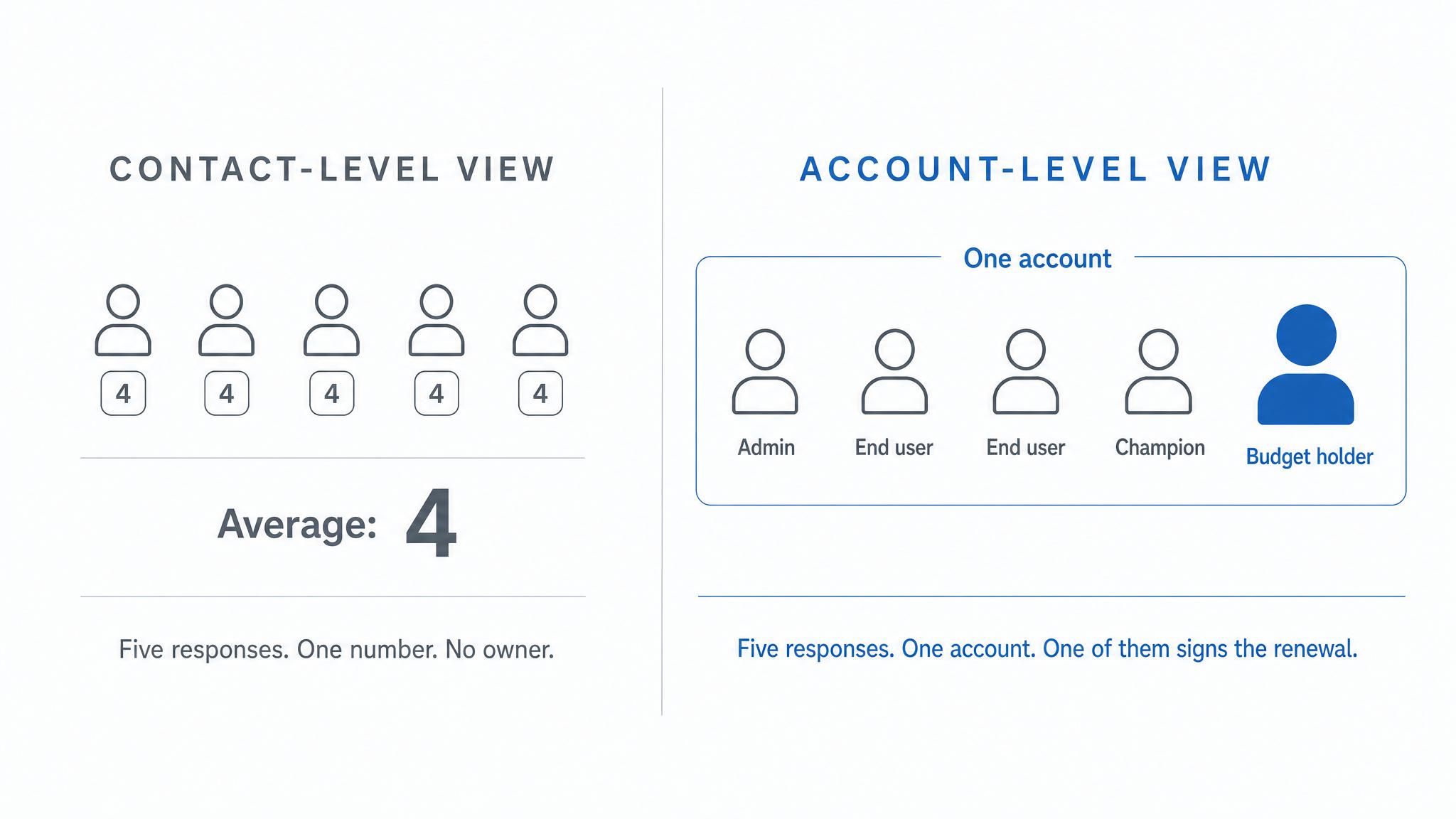
In B2B the unit of personalization is usually the account rather than the person, which changes the shape of the problem. Five people at the same customer firm may need five different things from the same product in the same week. The administrator, the daily user, the executive sponsor, and the person who signs the contract are rarely served well by the same message.
Agent assistance and copilots
Rather than removing the person handling the conversation, this category makes that person faster. AI drafts a response for an agent to edit. It surfaces the account history that would otherwise take four minutes to find across three systems. It summarizes a long thread so whoever picks it up next doesn’t have to reinvent the wheel.
This is among the least contested applications of AI in customer experience. The human stays in the loop, the customer gets a better answer sooner, and nobody has to be frustrated that a machine might have misunderstood the query.
Predictive and proactive service
Prediction is where AI CX starts to look different from automation. Models read patterns across usage, support volume, sentiment, and engagement to flag a problem before the customer reports it. A drop in logins from a power user. A support pattern that has historically preceded a downgrade. A stakeholder who has stopped replying to anyone.
The value here is timing. A problem caught while it is still a signal costs far less to resolve than the same problem caught after it arrives as a cancellation request.
Feedback and account intelligence
The final category tends to get listed last, but for B2B companies it belongs first. Businesses collect enormous quantities of feedback: surveys, support transcripts, public reviews, sales-call notes, product telemetry, notes from the field. Historically almost none of it was read in full. A team sampled it, charted a score, presented the chart, and moved on.
AI changes those economics. Every response can be read, categorized, and connected back to the account it came from and the revenue that account represents. Reading and cross-referencing the entirety of the feedback is a different capability from merely summarizing a support queue.
AI CX is not just the help desk
This is where the standard treatment of AI customer experience becomes inadequate for B2B.
Categorical and definitional searches tend to revolve around support. Deflection rates. Ticket volume. Time to first response. Those definitions were written for companies whose customer relationship is largely transactional. For B2C, this is correct.
This is where B2B AI spending lands in the wrong place, however.
Why the chatbot-first framing shortchanges B2B
A support-first definition optimizes for the volume of interactions a company can handle. That’s a sensible goal when interactions are numerous, short, and low-value individually.
B2B inverts every one of those conditions. Interactions are fewer. They are longer. They carry more context, more weight. And any single one of them can be the conversation that decides a renewal or cancellation. Optimizing for deflection is optimizing the wrong variable. A company can improve every support metric it tracks and still lose the account, because the thing that lost the account was never a support ticket in the first place.
The signal that predicted the loss lived somewhere else: in a survey response nobody routed, in a champion who left and was never replaced, in a decline in usage inside one business unit that no support queue would ever surface.
The account-level view: feedback, usage, relationship health, and revenue in one picture
The alternative is to treat the whole account as the unit of analysis rather than the individual ticket or contact.
At the account level, the question changes from how quickly a company answered to how well it understands the complexities of the relationship. Who at this account is engaged and who has gone silent? What has the account told the company, across every channel, in the last two quarters? How does that compare to accounts that renewed and to accounts that did not? What is this relationship worth, and what would replacing it cost?
Answering those questions requires connecting data that most companies keep in separate, bucketed systems: feedback in one tool, product usage in another, contract value in a third, and the relationship history in a spreadsheet somewhere. AI is useful here for an unglamorous reason. It can read across all of these tools at once, at a scale and speed no team can match, and it can do it every day rather than once a quarter.
Contact-level signals versus account-level signals
The distinction between a contact and an account is the whole difference, and it is easy to miss.
A contact-level view treats every respondent as an individual data point. One person scores the company poorly, and the company sees one unhappy person. An account-level view asks a different question: who is this person, what do they control, and what do they represent?
A detractor who administers a tool or product is a support problem. A detractor who owns the budget is a revenue problem. They may submit identical scores on an identical survey. Treating those two responses as equivalent is the most expensive averaging error in B2B customer experience, and it is exactly the error that account-level analysis exists to prevent.
See how account-level customer experience works in practice
Book a demo
How B2B companies use AI to improve customer experience
The categories below are where AI produces the clearest return for B2B. The order matters: the account-level uses come first, and the support-desk uses close the list because they still belong on it.
Reading every piece of feedback instead of a sample
Traditional feedback programs sample. A team spot checks verbatim comments, tags what it can, and reports the score. Everything unread is treated as though it said the same thing, which is a substantial and risky assumption on which to build a whole retention strategy.
AI removes the constraint that forced this kind of sampling. Every open-text response, every support transcript, every review can be categorized by theme, sentiment, product area, and severity. The output is not a longer report. The output is the ability to say what a specific account said, in its own words, without anyone having to rifle through a mountain of documentation.
Categorization at scale also changes a company’s high-level view across time. One quarter of feedback may capture a mood. Several years of consistently categorized feedback can identify a pattern: which complaints recur, which ones stop after a product change, which ones tend to precede a cancellation, and which ones a company has been hearing continuously without ever registering them as a common thread. A sampling program cannot provide that kind of insight.
Connecting feedback to accounts and to revenue
A complete read is only useful if it’s attached to something. The high-value step is joining feedback to the account record and to the hard revenue that account carries.
Once those are joined, ordinary questions become answerable. Which accounts raised the same issue this quarter? What is the combined contract value of the accounts raising it? Which of them are inside a renewal window? Which of them have a champion who has gone quiet? A customer experience program that can answer those questions is making a business case to a Board rather than just reporting on a score.
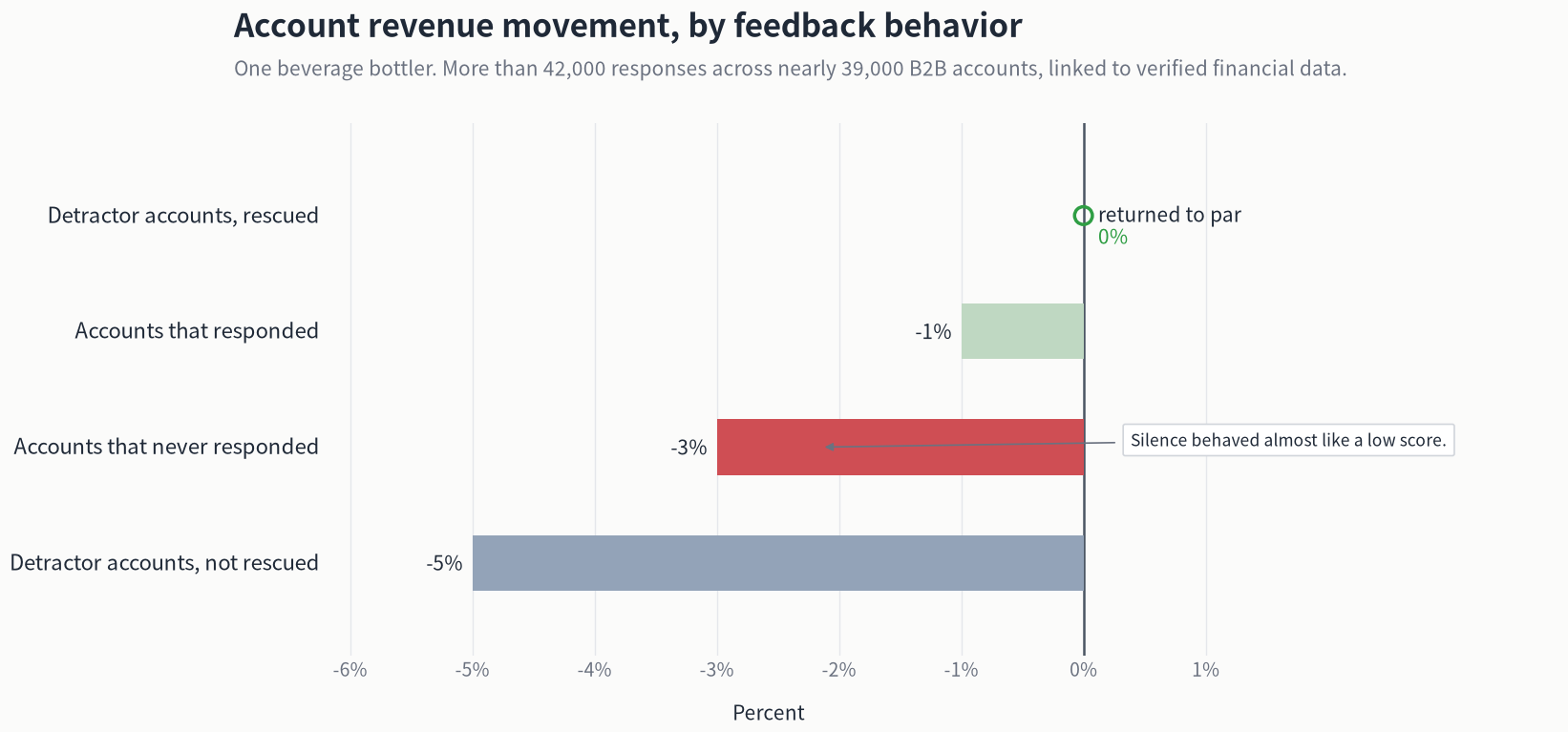
CustomerGauge measured exactly this with a leading beverage bottler in Asia, which linked more than 42,000 survey responses across nearly 39,000 B2B accounts to revenue verified against its own financial system. Detractor accounts that were rescued returned to par. Detractor accounts that were not rescued shrank by 5 percent. Accounts that never responded at all shrank by 3 percent, against 1 percent for accounts that did respond, which means silence behaved almost exactly like a low score. The revenue at risk was not hiding in the feedback. It was hiding in the accounts that sent none, and no contact-level view would have surfaced them, because there was no contact to look at.
Closing the loop while it still matters
Most companies collect more feedback than they act on. The gap is rarely intentional. It is routing. A detractor response arrives, sits in a queue, and reaches an owner three weeks later, by which point the customer has given up or moved on.
AI shortens that path. A response can be classified, prioritized by account value and renewal proximity, and routed immediately to the person who can act on it, without waiting for a human to manually triage the queue. The company is not just faster. It is faster on the responses where speedy responses change the outcome.
A customer who tells a company something and hears nothing back learns not to bother next time, which degrades the data along with the relationship. Closing the loop is a feedback program customers can see.
Where the help-desk uses still fit
None of the above replaces support-desk applications. Self-service still removes friction from routine questions. Agent copilots still make a support team faster and more consistent. Intelligent routing still gets the right question to the right person.
Those systems are worth building. Our argument is about sequence and proportion, not about merit. A B2B company that has automated its help desk but failed to connect feedback to its accounts has improved the cheapest part of the relationship at the cost of the highest value piece.
What separates good AI CX from bad AI CX
Customers can tell the difference immediately even when the company deploying it cannot.
Good
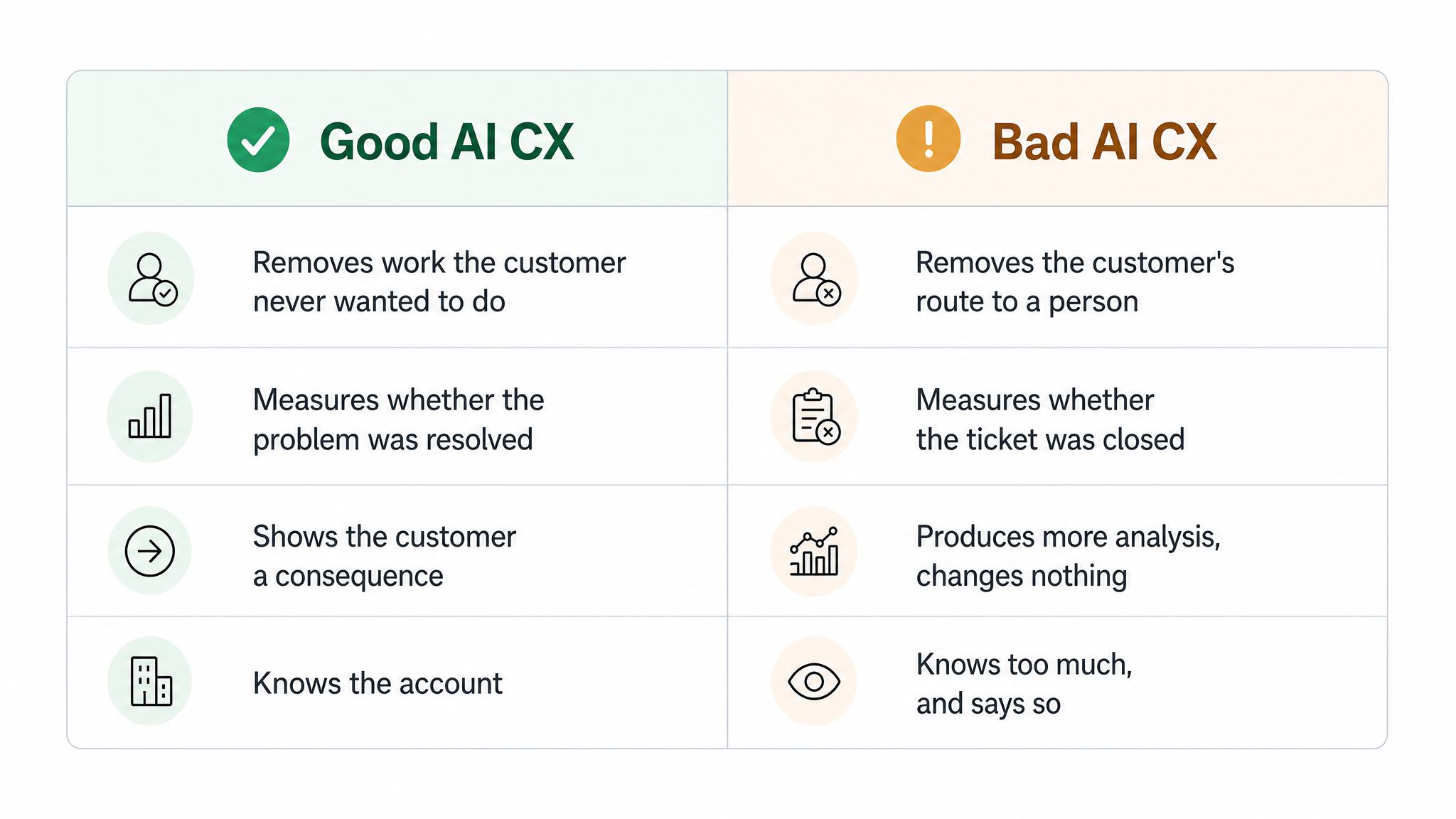
Good AI CX removes work the customer never wants to do. It shortens the path to an answer, and it leaves a clear route to a person the moment the automated path stops helping. That route is visible, it is one step, and it does not require the customer to arm wrestle a chatbot to reach it.
Good AI CX also measures the correct metric. The question is whether the problem was resolved, not whether the ticket was closed. Those two metrics diverge constantly, and only one of them describes the customer's actual experience.
Applied to feedback, good AI CX means the customer sees a consequence in a timely fashion. Something they said produced a change, or at minimum an acknowledgment from someone who could act on it.
Bad
Bad AI CX is deflection disguised as service. The company reports lower ticket volume and calls it efficiency, when what happened is that customers gave up. The metric improved because the relationship was damaged.
Bad AI CX also personalizes past the point of comfort. There is a line between a company that clearly understands an account and a company that appears to have been reading over someone's shoulder. B2B buyers are professionals, and they notice when a vendor knows something it has no clear reason to know.
The third failure is more common. A company deploys AI across its feedback program, produces more analysis than it did before, and changes nothing as a result. More insight with no change in behavior is a reporting upgrade, not a focused customer experience program.
How to start with AI customer experience
Most companies do not need a new data strategy to begin. They need to use the data they already have.
Start where the data already is
Almost every B2B company sits on years’ worth of unread feedback, support history, and usage data. That corpus is the strongest available starting point, and it has the advantage of describing real customers rather than hypotheticals.
A practical first step is to take one existing source (feedback is usually the best candidate) and connect it to the account record and the contract value. That single join produces more actionable insight than most new data collection, because it converts a score into a list of named accounts with money attached.
Starting with existing data has a second advantage: it produces a test rather than a commitment. A company can complete a join on one segment, or one region, or only the accounts renewing in the next two quarters, and then determine whether the output would have changed a business decision. If it would not have, that is worth learning before the decision is made. If it would have, the case for the wider program comes out of the company's own hard data rather than a third-party vendor's.
Measure outcomes, not activity
A defective AI initiative measures the volume of work the system performs. Responses categorized. Tickets deflected. Summaries generated. Those numbers always go up, which is what makes them attractive (and useless).
Measure outcomes instead. Retention in the accounts where the program routed a signal to an owner. Revenue retained in accounts flagged as “at risk.” Time from a detractor response to a real human contact. Those numbers can go the wrong way, which is precisely why you ought to be tracking them closely.
The bottler described earlier is the clearest worked example of what those measurements produce. Across more than 7,200 scored accounts, one point of NPS tracked to roughly one point of three-year revenue growth, at a correlation of 0.91. Promoter accounts carried twice the annual account value of detractor accounts. Those are retention and expansion numbers rather than activity numbers, they were produced by joining feedback to accounts and to revenue, and they are the kind of numbers that survive a budget review.
Frequently Asked Questions
What is an example of AI customer experience?
A common example is a chatbot that resolves a routine question without a queue. A more consequential example for B2B is a system that reads every survey response and support transcript, connects each one to the account and contract value behind it, and routes a detractor response from a budget holder to an owner the same day rather than three weeks later.
What is the difference between AI customer experience and AI customer service?
AI customer service is a subset of AI customer experience. Customer service covers the support relationship: questions, issues, and their resolution. Customer experience covers the whole relationship, including onboarding, product usage, feedback, renewal, and the account relationship itself. A company can have excellent AI customer service and still have no view of whether its accounts are healthy.
What qualifies as AI customer experience?
Any application of artificial intelligence to understanding or improving how customers experience a company qualifies. In practice the category covers five areas: self-service and conversational AI, personalization, agent assistance, predictive and proactive service, and feedback and account intelligence. For B2B companies the last of these carries the most value, because it is the one connected to revenue.
What are the top trends in AI for customer experience?
Three directions are visible across the category. Analysis is moving from sampled feedback to complete feedback, because reading everything is no longer cost-prohibitive. Measurement is moving from activity metrics toward retention and revenue outcomes. And in B2B specifically, the unit of analysis is moving from the individual contact toward the account, since account value rather than response count is what determines the consequence of getting it wrong.
How is AI customer experience different for B2B companies?
The difference is account structure. A consumer business may serve millions of customers whose individual value is small, which makes volume and deflection sensible things to optimize. A B2B business may serve a few hundred accounts, each carrying substantial contract value, several stakeholders, and a renewal date. In that setting the highest-value use of AI is not handling more interactions. It is understanding each account well enough to act before the relationship changes.
Turn account feedback into a revenue conversation
Book a demo
Related resources
About the Author