



What Is Customer Sentiment Analysis? A B2B Guide
Customer sentiment analysis is the process of reading customer feedback, such as survey comments, emails and call transcripts, and classifying the feelings in it as positive, negative or neutral, usually with assistance from AI. For B2B companies, the real value comes from rolling sentiment up to the account, weighing it by revenue and tracking it over time.
- Customer sentiment analysis reads what customers write and say and labels the feeling behind it, usually with AI.
- Reading sentiment by topic shows what customers feel strongly about, not only how they feel.
- In B2B, sentiment is read by account and by role, because executives and frontline users rarely feel the same way about a vendor.
- The direction of sentiment over time matters more than any single score.
- The output that matters is a list of accounts trending negative and what they are worth.
What is customer sentiment analysis?
At its core, customer sentiment analysis is the practice of analyzing what customers say about a company and classifying the feeling behind it, usually with the help of AI. The input is text: survey comments, support tickets, emails, call transcripts and reviews. The output is a label, either positive, negative or neutral, often with a score and a topic attached. The sheer volume of this information makes reviewing every comment by hand an enormous drain on time and resources, leading many teams to turn to AI.
Sentiment analysis is one of the clearest ways to take the temperature of your customer base. It answers three questions: How do customers feel? Why do they feel that way? Are their feelings changing over time? A program that answers only the first question is essentially a mood ring, but one that answers all three gives teams a clearer idea of where to take action.
Sentiment is not the same thing as satisfaction or the Net Promoter Score (NPS). NPS records the number a customer chooses when asked how likely they are to recommend you; sentiment analysis, on the other hand, reads the words around that number. Two customers can give the same score, but for very different reasons: one is content yet unexcited, while the other is just one bad week away from looking at a competitor. The score tells you where a customer stands, while the comment tells you why.
What is customer sentiment?
Customer sentiment is much like how it sounds: it is the sentiment, or feeling, a customer holds toward a company, its product or its service at a given moment. It shows up in the written and verbal feedback customers provide, as well as changes in how they engage and respond over time. A sentiment score translates the feeling into a number that can be tracked over time, usually on a scale that runs from negative to positive.
Customer sentiment should not be confused with consumer sentiment. The Consumer Sentiment Index measures how households feel about the economy, whereas customer sentiment is narrower and more useful to a business: it is about how your customers feel about you.
How customer sentiment analysis works
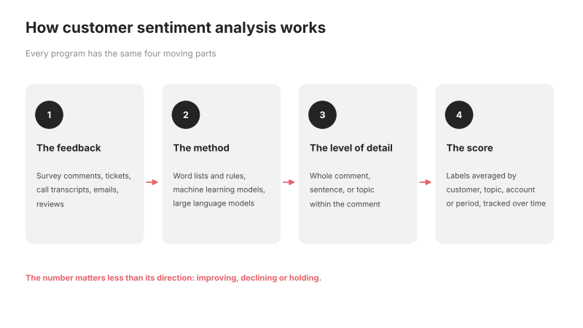
Every sentiment program has the same moving parts: the feedback it analyzes, the method it uses to analyze it, the level of detail it examines, and the score it produces.
Where the feedback comes from
Sentiment analysis works on any text a customer produces. The most common sources are:
- Open-ended survey comments, especially the follow-up question after an NPS or Customer Satisfaction (CSAT) score
- Support tickets and chat logs
- Call and interview transcripts
- Emails to account managers and customer success teams
- Public reviews
How the text gets read
There are three broad methods for sentiment analysis, and most tools now combine them to capitalize on the strengths of each.
- Word lists and rules: The system looks for words identified as positive or negative and adds them up. It is fast and easy to audit, but it also misses sarcasm, nuance and context.
- Machine learning models: A model learns from comments that people have already labeled. It handles context better than word lists, but it needs good training data and can drift when the language of the business changes.
- Large language models (LLMs): Models like the ones behind ChatGPT read whole comments the way a person does, handle nuance well, and can explain why they chose a label. They can perform sentiment analysis well, as long as the instructions are clear and someone checks a sample of the results against their own reading.
The level of detail
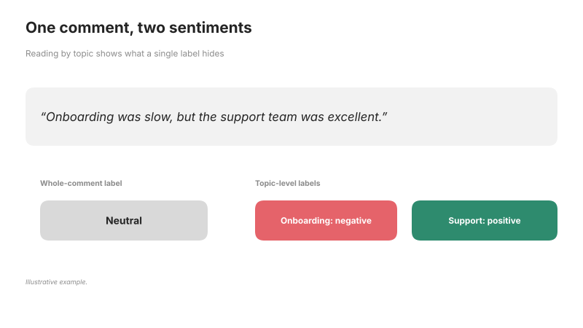
Sentiment analysis can look at an entire comment, individual sentences, or specific topics within that comment, which is where the useful details are. For instance, "Onboarding was slow, but the support team was excellent" carries two sentiments about two topics, but a single label for the whole comment would hide both.
From labels to a score
A sentiment score turns labels into a number that can be tracked over time. Each label is assigned a value, weighed by how certain the model is, and averaged across comments for a customer, a topic or a period. The number matters less than its direction: is sentiment improving, declining, or staying the same?
In B2C: one contact, one sentiment
A consumer brand usually reads each customer on their own. Their experience with the brand, from purchasing and using the product to deciding whether to return, is a single customer relationship, so the analysis can stop there.
In B2B: many contacts, one account
B2B, however, does not work that way. A single customer account can include a group of people in different roles, and they rarely feel the same way about a vendor at the same time. CustomerGauge reads account sentiment from 6 to 8 contacts in each account, identifies each contact by role (executive, middle management and frontline), and analyzes the sentiment of each group. The overall health of an account is diagnosed from how those groups compare, not from a single average.
Two patterns show why the comparison matters:
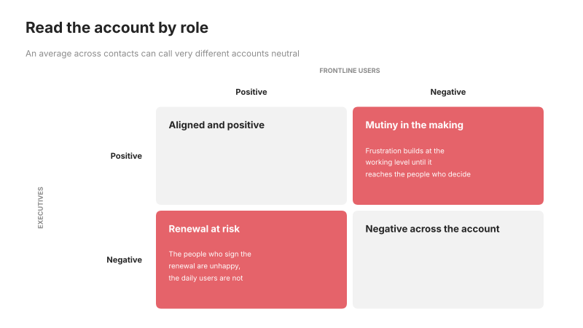
- Executives are positive but frontline users are negative: The people who use the product every day are unhappy, whereas the executive sponsors are satisfied. That is a mutiny in the making, with frustration building at the working level until it reaches the people who decide.
- Executives are negative but frontline users are positive: The daily users are pleased with the product, but the people who sign the contract renewal are not, putting the account at risk of churn.
An average across every contact could call both of these accounts neutral. Reading by role, however, shows two different problems, each with its own issue to fix.
Customer sentiment analysis examples
The examples below are illustrative and not based on actual customer data.
- A renewal comment from an executive sponsor: "We're getting value, but every renewal turns into a price negotiation and we're losing patience with the process." Sentiment: mixed, leaning negative. Topics: value (positive), commercial process (negative). Coming from an executive involved in the renewal decision, this is a renewal risk worth a conversation now.
- An onboarding complaint from a frontline user: "We are weeks in and we still can't get the integration to sync with our CRM." The sentiment is negative; the topic is onboarding and integration. One comment like this is a support ticket, but several from the same account point to an adoption problem.
- Praise for an account manager: "Our account manager is excellent. She is always responsive about our concerns." Sentiment: positive. Topic: account management. It shows who is helping maintain a strong customer relationship, and that their effort is worth investing in.
- Silence from a former champion: A contact who answered every survey for two years has stopped responding. There is no comment to label, and the absence of that feedback can be an early warning of dissatisfaction or churn.
Why B2B sentiment analysis is different
Most sentiment tools were built for support queues and contact centers, where each ticket is its own story, but B2B accounts need a different approach.
- One account, many voices: Building on the role-level reading discussed above, sentiment is rolled up to the account and weighed by revenue, so the accounts that matter most are read first. In CustomerGauge, Account-Centric NPS® rolls feedback from every stakeholder into one account-level view, and Revenue-Based NPS® ties that view to the revenue each account carries.
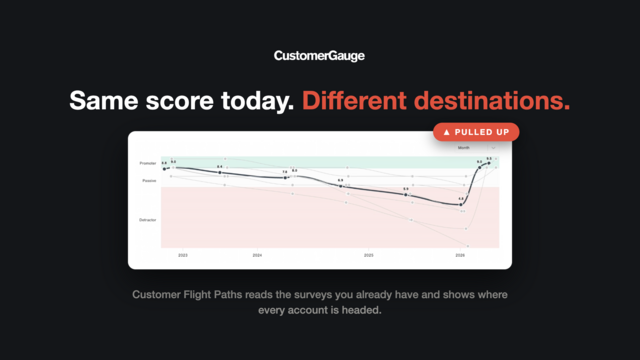
- A trajectory, not a snapshot: Sentiment read across successive responses shows whether an account is climbing, sliding or staying the same. A neutral account that was positive last quarter is a different conversation from a neutral account that was negative. CustomerGauge applies the same idea in Customer Flight Paths, which connect every survey response an account or contact has given into one of six shapes, such as Level Flight, where a promoter stays a promoter, and Descending, a gradual slide from promoter to detractor. The comments along each path show why it moved.
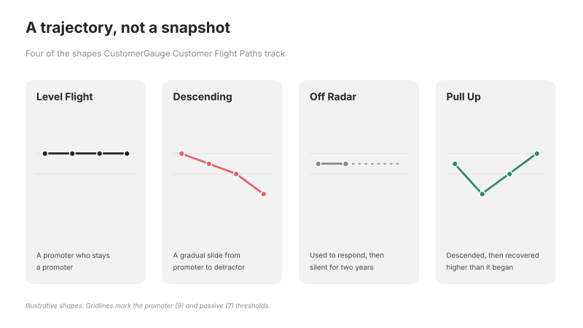
- Silence is loud: A contact who is suddenly silent can signal something written feedback cannot. In B2B, the people who go quiet are often the ones closest to the renewal decision. Customer Flight Paths call this pattern Off Radar: a contact who used to give feedback and has gone silent for two years. Those contacts make a ready outreach list.
- From sentiment to revenue at risk: The end of the analysis is not a sentiment chart, but rather a list of accounts trending negative along with their value, so those who can act know where to start.
How can teams use sentiment analysis to improve customer experience?
The analysis earns its keep when it gives teams a road map for their next steps.
- Find root causes by topic, not only by score: A falling score says something is wrong; topic-level sentiment says what, whether it is onboarding, pricing, product gaps or support.
- Close the loop while it can still be fixed: Negative sentiment from a key contact should reach the account owner quickly, with the comment attached, so they can prioritize follow-up before the issue escalates and frustration grows. CustomerGauge's Close the Loop AI Assistant drafts that follow-up from the score, the NPS drivers and the comment.
- Brief account teams before renewals and QBRs: A review of how each role in the account feels, and how those feelings are changing, makes a renewal call or QBR a more productive and informed conversation.
- Check whether sentiment improves after an issue is resolved: For example, if a team fixes an integration problem, sentiment on that topic should improve in the account that raised it. If it does not, the team may need to take another look at the solution.
- Learn from the accounts you rescued: In Customer Flight Paths, a Pull Up is an account that was descending and recovered, often to a score higher than where it began. CustomerGauge found a consistent pattern in the comments on these accounts: decline is operational, with complaints about delays, friction and process, while recovery is human, and rescued customers name the specific person who turned things around. Reading those comments shows what a rescue looks like, and that, in turn, can become a playbook.
Where sentiment analysis goes wrong
Sentiment analysis is valuable, but it is not foolproof. There are a number of ways that it can give teams an incomplete picture.
- Missing context or nuance: "Great, another update that breaks our reports" reads as positive sentiment to a word list, even though it is clearly sarcasm. Mixed comments get mislabeled unless the analysis works at the topic level.
- Relying on small samples: A B2B account may have only a handful of respondents, so one comment can have an outsize influence. Be sure to look at the people behind the number before drawing conclusions about the account.
- Trusting the label alone: A positive or negative label does not tell the whole story. Teams that read a sample of comments every cycle catch the model's mistakes and learn things no label captures.
- Relying on only one feedback channel: Survey comments, support tickets and calls capture different parts of the customer experience. An account that looks calm in surveys can be loud in support, and looking across channels paints a more complete picture.
- Careless handling of personal data: Customer feedback may contain personal information or sensitive company information. Check what an AI tool keeps and how it uses the data before feeding it customer feedback. CustomerGauge, for example, obfuscates personal and business data before AI processing.
How to start with customer sentiment analysis
- Start with the open-ended survey comments, tickets and call notes your company already collects. That is enough to begin.
- Choose the topics that matter to your business, such as onboarding, support, product, pricing and the account relationship, then review a sample by hand to make sure the sentiment labels accurately reflect what customers are saying.
- Read sentiment on a regular cycle, as you would with NPS, so you can spot trends before they become surprises.
- Connect sentiment to accounts, roles and revenue before reporting it to leadership, so they can see where action is needed. A single company-wide sentiment number cannot show that.
Inside CustomerGauge, this is the work of Gaige AI. It applies text and sentiment analysis to spot trends and detect shifts in feedback, writes AI Relationship Summaries that point sales and customer success teams to the highest-value next steps, and runs the deeper Flight Path analysis.
About the Author