



Customer success involves helping customers get the results they expect from a product, giving them a reason to renew, expand or recommend it. Whereas customer support reacts to problems, customer success teams take a proactive approach. In B2B, a customer is not one person but an account with many people in it; customer success should hear from all of them.
- Customer success works proactively to help customers achieve the outcomes they expect from a product, so they stay, renew and buy more.
- Customer support takes on problems as they arise; customer success works ahead of them. Customer experience (CX) is built around the contact, customer success around the product and its subscription, and account experience (AX) around the whole B2B account, in any industry.
- The work follows the customer lifecycle: onboarding, adoption, value, renewal and expansion.
- In B2B, customer success teams can borrow the AX approach: gather feedback from every role across an account, analyze it by role and weigh it by revenue.
- The key metrics for measuring customer success are net revenue retention (NRR), churn, account health and Net Promoter Score (NPS) analyzed by role.
What is customer success?
Customer success focuses on building long-term relationships by proactively helping customers make the most of the products and services they purchase. When customers see a good return on their investment, they will have a reason to stay, renew and buy more.
The term refers to both a function and an outcome. As a function, the customer success team provides guidance and support after the sale. As an outcome, it means customers actually succeed with the product they bought. The two go hand in hand, with the team's performance measured by how successfully customers meet their goals.
Customer success management puts this approach into practice. It involves understanding what customers want to accomplish, tracking progress, spotting risk early and stepping in before a small problem leads to nonrenewal.
The discipline arose from the subscription software industry, where revenue depends on customers continuing their subscriptions year by year or month by month. Our brief history of customer success explores how the discipline took shape.
Why customer success matters in B2B
In B2B, a company's revenue may depend heavily on a small number of large accounts. Losing just one of these customers can have a significant financial impact, creating pressure to replace lost business.
Subscription models raise the stakes further as customers regularly decide whether to renew. Retaining and expanding existing accounts often matters as much to growth as bringing in new business. Our guide to SaaS B2B customer retention covers the metrics, benchmarks and strategy behind keeping customers.
This is where customer success plays an important role. By maintaining regular contact with customers, the customer success team is often the first to see product adoption stall, a champion leave or a new executive start asking hard questions about value. Spotting that months before the renewal date turns a likely loss into a relationship that can still be saved. For more on keeping accounts, see our articles on account retention and how a retention-focused strategy drives growth.
Customer success vs. customer support, customer experience and account experience
Customer success and account experience both sit within the customer experience market: account experience serves its B2B half, while customer success is a smaller segment focused on SaaS (software as a service), tech and the subscription economy.
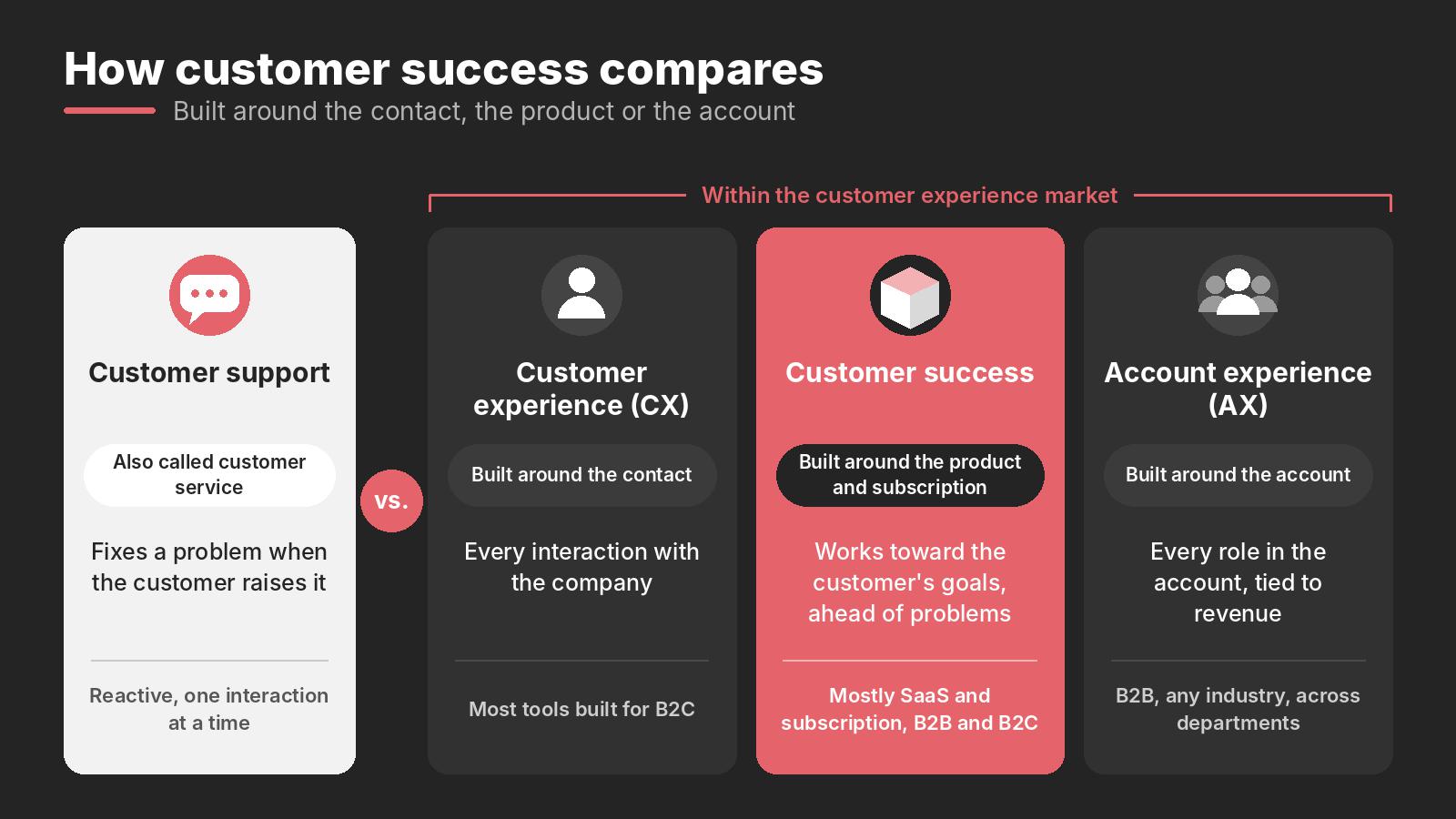
Customer support, also called customer service, helps a customer troubleshoot and fix problems with a product or service. Whether someone opens a ticket, sends an email or picks up the phone, the support team tackles the issue. It is transactional, reactive work, and it is measured one interaction at a time.
Customer success is built around the product and its subscription. It mainly serves SaaS and other subscription businesses, B2B and B2C alike, and traditionally sits in one department: customer success. Unlike support, it takes a proactive approach by not waiting for issues to surface. Rather, it tracks whether the customer is getting value and steps in if progress appears to stall. It works toward the customer's long-term goals rather than any single request.
Customer success often overlaps with account management; it drives adoption and value while account management tends to own the commercial side of the relationship, such as renewal terms and additional sales. In many teams, the two share the account, making it important that both have a clear picture of the customer relationship. Our account management guide offers more detail on the commercial role.
Customer experience (CX) is built around the individual contact. It includes every interaction a customer has with the company, from the first marketing email and sales conversation through onboarding, billing, support and renewal, and no single team owns it. Most CX tools were built for consumer (B2C) businesses, where the customer is usually one person. CX programs are good at improving operational processes, but their results are hard to tie to revenue. Our guide to customer service vs customer experience compares the two in more detail.
Account experience (AX) is built around the whole account. It applies to B2B companies in any industry, software included, and works across departments. In B2B, the customer is an account with many people in it, from the decision makers who sign off on a purchase to its everyday users. Our guide to account experience explains how AX works. What sets AX apart is that it ties what every role says to the account's revenue, pointing teams to the relationships with the most at stake.
How customer success works across the customer lifecycle
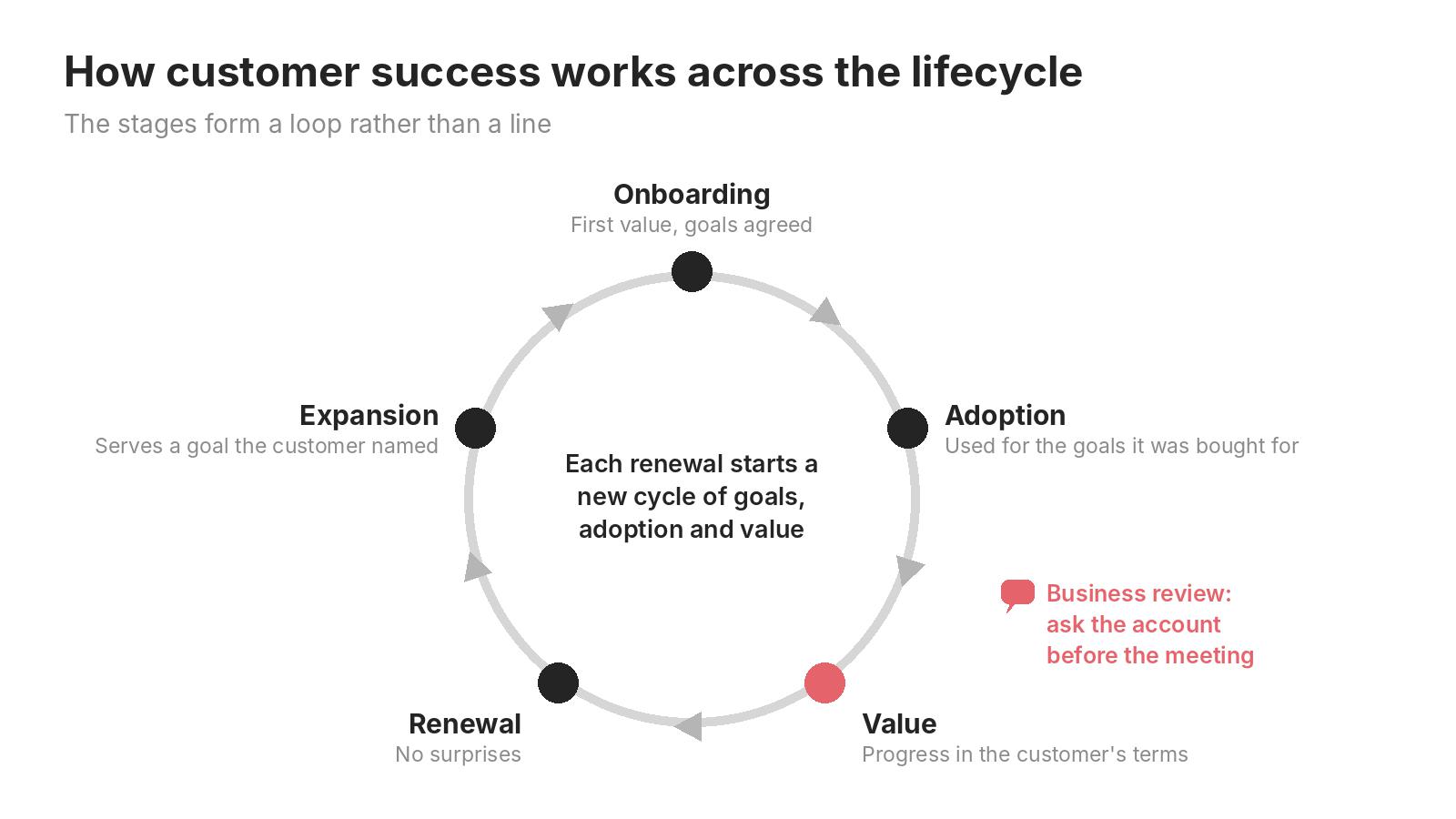
Customer success plays a role at every stage of the customer relationship, from the signed contract to the next renewal and beyond.
Onboarding
Onboarding helps the customer see value from their investment as quickly as possible. Clear goals are established at the start: what the customer wants to achieve, how both sides will measure progress and who on the customer's team is responsible for what. A slow or confusing onboarding sets the tone for a frustrating customer experience.
Adoption
Adoption is the point where the product or service becomes a part of the customer's operations and serves its intended purpose. Logins alone are not an accurate measure of successful adoption; a team can sign in every day and still miss the features that make the biggest difference.
Value
Value means showing that the customer is getting the benefits they expected, using measures that matter to them. Customer success translates usage into meaningful results for the customer.
Renewal
Renewal should present no surprises; both the customer and the company should already know where the relationship stands. If potential problems were handled months earlier, the renewal conversation should confirm the customer's decision. If concerns first surface in the renewal meeting, it may be too late to save the relationship.
Expansion
Expansion follows value. Opportunities to add new products, seats or services should support the customer's goals, not simply fill a quota.
The stages of the lifecycle form a loop rather than a line: each renewal starts a new cycle of goals, adoption and value. Our guide to account lifecycle management sets out best practices.
Key elements of a B2B customer success strategy
A customer success strategy helps teams decide where they spend their time and how to best apply what they learn. Five elements help put this strategy into practice.
Segment accounts by revenue and complexity
Not every account needs the same treatment. Segment accounts by revenue and complexity, then match the level of support to each group: dedicated, personalized attention from a customer success manager for the largest accounts, and lighter support for the rest.
Write a success plan for each key account
A success plan outlines the customer's goals, the milestones to reach them, the owners on both sides and the risks that could get in the way. It gives the customer and the customer success team a shared plan that both sides can check progress against.
Treat the business review as customer success work
A quarterly business review (QBR) gives key decision makers from the customer account an opportunity to review results against their goals. Customer success takes ownership of the QBR to demonstrate value, identify risk and work to agree on what comes next. Three habits make it work.
- Gather feedback before the meeting. Send a short survey to people across the account, including those who will not attend, to get a sense of where they stand before anyone walks into the room.
- Read the survey responses by role. An executive may have a different view of the product's return on investment than someone who uses it every day. Both perspectives should be considered.
- Close the loop after. Address the concerns raised in the meeting, and report back to the account on what changed.
Build playbooks around triggers
Playbooks outline what the team should do when a specific event happens, such as a champion leaving, usage falling or a new executive joining the account. Tying each playbook to a trigger helps the team act as soon as an issue arises, not when someone happens to notice it.
Close the loop on what customers say
Feedback builds trust when customers see results. Closing the loop means following up with the person who reported an issue, making a sincere effort to repair it and telling customers what changed as a result. Our guide to closing the loop explains how to put this process into practice.
Hear from the whole account, not just one contact
A health score built from product usage tells you how an account uses the product: how often people sign in, which features they use, and how many seats are active. What it does not reveal is what the people who decide on renewal think.
That distinction matters because the renewal decision often sits with people who seldom use the product themselves. Hearing from every role is the account experience approach, and customer success teams can use it.
Ask every role in the account
An account is a group of people with different stakes in the relationship. The executive sponsor cares about the return on the investment. Other decision makers weigh cost, risk and whether the product meets the company's needs. Influencers shape opinion inside the account, and users live with the product day to day. Each of them sees the relationship differently, and each can shape whether it continues.
A short relationship survey can gather feedback from all of them: a score and one open question for each person.
Read the answers by role
Feedback is more valuable when it is analyzed by role. Users can be happy with the product while the executive sponsor questions the return on investment. An account average will hide those differences, masking a renewal risk that no usage chart can show. Our post on land and expand strategy makes the case for knowing what decision makers, influencers and end users each think.
Treat silence as a signal
Sometimes, silence from any role speaks volumes. When an executive sponsor stops responding, it may signal a gap in the relationship at a level where renewal decisions are often made. Our article on the hidden churn indicator explains why an account that has gone quiet deserves attention.
Weigh what you hear by revenue
Not all accounts generate the same revenue, so their feedback should not carry the same weight when you decide where to act first. Weighing feedback by revenue prioritizes the accounts with the most at stake and the weakest sentiment. A detractor in a small account and a detractor in your largest account may share similar concerns, but the potential financial impact is very different.
Read the comments by theme and by account
Survey scores show where an account stands, while comments help explain why. Reading the comments by theme across the customer base can reveal common patterns, and reading them by account can show what each relationship needs. Learn more about both approaches in our guide to customer sentiment analysis, or see our account experience guide to understand different stakeholder perspectives.
Choose measures that fit each role
A frontline user can tell you how intuitive the product is, while an executive can tell you whether the relationship is worth renewing. For more on choosing the right measures to use and when, see our guide to voice of the customer metrics.
CustomerGauge's Account-Centric NPS brings the feedback from every role into one account-level view, and Revenue-Based NPS connects that feedback to account revenue. This helps teams see risk while there is still time to act on it.
Customer success metrics that matter in B2B
Customer success metrics help companies understand whether the account base is growing, holding or shrinking, and why. Four carry most of the weight.

Net revenue retention and gross revenue retention
Net revenue retention (NRR) shows whether recurring revenue from existing accounts grows or shrinks over a period, counting expansion as well as losses. Gross revenue retention (GRR) leaves expansion out and shows how much existing revenue a company holds on to. Our guide to net revenue retention covers the measure in depth.
Churn
Churn measures two types of losses. Logo churn tracks the number of accounts lost; revenue churn counts the revenue lost when accounts leave or downgrade. The two can tell different stories, as losing a handful of small accounts can matter less than losing one large one. Analyzing churn by segment can reveal where the losses are concentrated. Our guide to customer churn management covers how to reduce it.
Account health
Account health should combine product usage and engagement with customer feedback. Usage shows the level of activity, while feedback shows sentiment.
NPS read by role and weighed by revenue
The Net Promoter Score (NPS) comes from one question: how likely someone is to recommend the company. It is calculated by subtracting the share of detractors from the share of promoters. In customer success, NPS is most useful when it is read by role, weighted by revenue, and tracked over time. A rising score among users and a falling score among executives in the same account, or the reverse, is a warning to act on.
For more, see our posts on customer success metrics and customer retention metrics.
The customer success team: roles and responsibilities
The customer success manager (CSM) plays a central role on the team. A CSM owns a portfolio of accounts and is responsible for onboarding, adoption, business reviews, renewal readiness and recognizing opportunities for growth. The CSM communicates customer goals internally and helps the customer recognize the value of their investment.
As teams grow, responsibilities are divided among different roles. In some organizations, account managers take on revenue growth while CSMs handle customer improvement and nurture. Strategic CSMs focus on the largest accounts, where the relationship involves multiple stakeholders and more revenue is at stake.
A CSM is not a support queue, and the role is not intended solely to meet sales targets. Our post on what a customer success manager does walks through their day-to-day responsibilities.
Customer success software: what the stack needs
Customer success relies on three kinds of tools. The first is a customer relationship management (CRM) system, which stores account information, including contacts, contracts, renewal dates and sales history. The second tool, a customer success platform, tracks health scores, triggers playbooks and organizes the team's work. The third tool is a feedback program that gathers input from every role in the account and helps teams turn that feedback into action.
These tools work best when they are connected. Customer success platforms can often collect survey scores and blend them into a health score, but that only tells part of the story. A more complete picture comes from analyzing feedback by role and weighing it by revenue, so the health score reflects how key decision makers view the relationship, not just what the product logs show.
About the Author